Location
Mount Vernon, WA 98274
Location
Mount Vernon, WA 98274

On parched landscapes where wind scours bare soil and rain vanishes in dust storms, microscopic communities of lichens, mosses and cyanobacteria form living crusts that anchor life's next wave. A new blend of drone mapping, lab-grown inoculants and indigenous stewardship is reviving these biocrusts, transforming deserts into resilient ecosystems and opening fresh avenues for carbon capture.
In a sunbaked test plot at the edge of the Sonoran Desert, researchers kneel by a shallow trench exposing a patchwork of pale rock fragments and loose sand. It’s here that a team of restoration ecologists is breathing life back into a landscape stripped by decades of off-road vehicle traffic and overgrazing. Their toolset spans drones buzzing overhead, portable soil-moisture probes at their feet and trays of cultured cyanobacteria ready for application by hand.
Illuminated by midday heatwaves, the soil’s surface looks dead-an expanse of shifting grit that barely holds together underfoot. Yet beneath a microscope lies a bustling microcosm of life known as biological soil crust, or biocrust: a thin veneer of mosses, lichens, green algae and filamentous bacteria. When intact, this living blanket glues soil particles in place, soaks up scarce rainfall and generates organic carbon in arid ecosystems worldwide.
Over the past decade, scientists have mapped biocrusts across millions of square kilometers, only to see them decline under human pressures and rising temperatures. Now, a pilot project led by a multidisciplinary team is testing techniques to kick-start crust recovery on barren lands. Their experiment spans three continents, fusing cutting-edge imaging with age-old land-use wisdom and novel microbial cultures to sow tomorrow’s living crust.
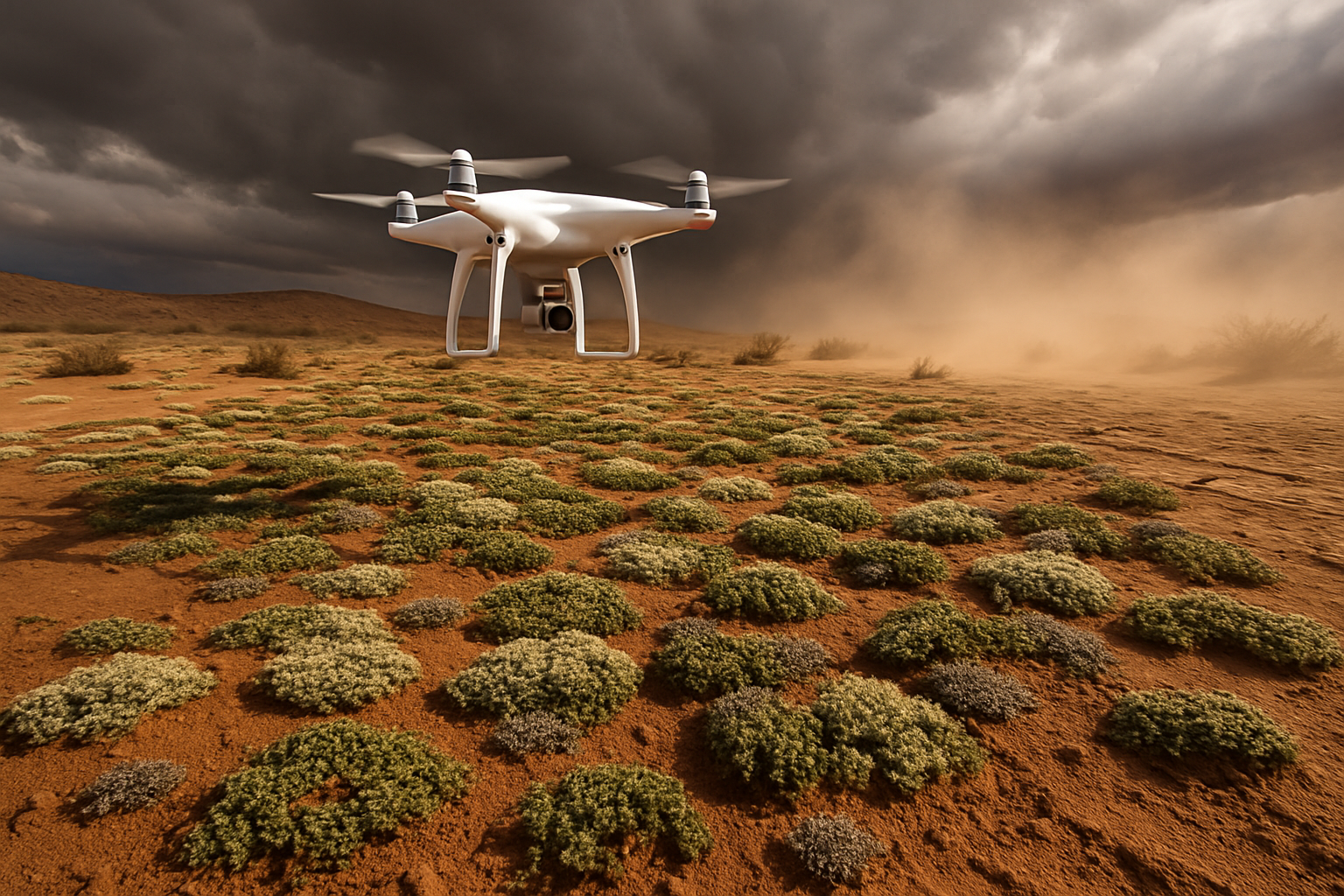
The first innovation involves drones equipped with hyperspectral cameras. Flying as low as ten meters above the ground, the sensors can distinguish living green patches from inert soil by detecting subtle differences in light reflectance across dozens of spectral bands. “Traditional field surveys take weeks to cover a few hectares,” says a restoration ecologist on site. “The drone scans can do 200 hectares in a morning, pinpointing where crust is stubbornly missing or has been disturbed.” This rapid mapping not only identifies priority zones for intervention but also tracks recovery over time, creating a dynamic restoration dashboard.
Back at a mobile lab van parked on a dry arroyo, microbiologists culture native cyanobacteria strains harvested from nearby undisturbed reserves. These filamentous bacteria are the primary architects of early-stage crusts, weaving networks that trap dust and seed later arrivals like lichens and mosses. The cultured biomass is blended into a carrier slurry of local soil and organic binder, then loaded into backpacks for field application.
On day three of the restoration trial, teams kneel in neat rows, gently pressing the dark green inoculant onto scraped patches of soil. “We’re basically giving nature a head start,” explains a microbiologist as she brushes the slurry into cracks and crevices. Trials in controlled environments have shown that treated plots can develop visible crust within six months-compared to years or decades for natural recovery.
While lab techniques provide speed and scale, the project’s social dimension depends on collaboration with indigenous land stewards. In the Great Victoria Desert of Australia, traditional custodians have long understood the fragility of the crust. Their lore decrees that young plants and elders must avoid walking on certain areas during the wet season, allowing the crust to absorb spring rains undisturbed. By integrating these customs into grazing schedules and low-impact tourism routes, the project is crafting a holistic roadmap for long-term success.
Across the Sahel in West Africa, another parallel trial combines drought-tolerant crop intercropping with biocrust patches around field edges. When rains arrive, mapped by a network of solar-powered weather stations, crops flourish in the sheltered microclimate created by living crust barriers that slow runoff and enhance infiltration. Preliminary data show up to a 15 percent increase in soil moisture retention near inoculated strips-a boon for farmers contending with erratic rainfall and advancing desertification.
Perhaps the most compelling outcome is carbon capture potential. Though each gram of biocrust fixes only minute amounts of carbon dioxide, scaling up crust restoration across millions of hectares could draw down substantial CO₂ over decades. Policy analysts are already discussing how to integrate biocrust credits into voluntary carbon markets. If successful, landowners and indigenous communities might receive payments for maintaining crust integrity, creating new economic incentives for sustainable land management.
Technical challenges remain. Culturing diverse cyanobacterial strains at scale demands sterile conditions and precise nutrient balances. Once applied, the inoculant is vulnerable to extreme heatwaves or sudden flooding. The drones’ spectral signatures can also be confounded by patches of dark volcanic rock or shadows cast by desert shrubs, requiring frequent algorithm refinements.
To address these hurdles, data scientists are training machine-learning models on terabytes of drone imagery and ground-truth samples. By feeding the algorithms examples of known crust types under varied lighting and soil conditions, the team hopes to reduce false positives and target treatments more effectively. A smartphone app under development will allow citizen scientists-from hikers to park rangers-to upload geo-tagged photos for real-time verification, crowd-sourcing the next wave of field data.
“Biocrust restoration sits at the nexus of technology, tradition and climate action,” reflects the lead ecologist. “If we get this right, it could transform how we think about drylands-from barren wastelands to thriving carbon sinks and biodiversity hotspots.”
As the sun dips below distant mesas, the drone returns to its charging station while the last of the inoculated plots is gently covered with a mesh to guard against wind scouring. In a few months, patches that look today like dusty scars may shimmer faintly green-evidence that even the harshest landscapes can be coaxed back to life with a mixture of science, community knowledge and a little microbial magic.
In a world racing against desertification and climate extremes, these pioneering trials may offer a blueprint for restoring millions of hectares worldwide, one microscopic organism at a time.