Location
Mount Vernon, WA 98274
Location
Mount Vernon, WA 98274


From backyard stargazing to deep dives into time dilation, this article invites readers on a journey of cosmic curiosity. We explore how simple tools, thought experiments, and citizen science projects turn the vast universe into a playground of wonder and discovery.
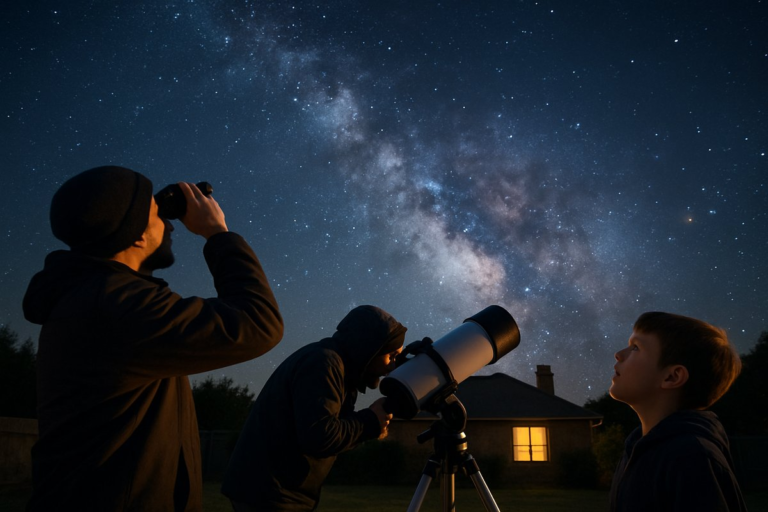
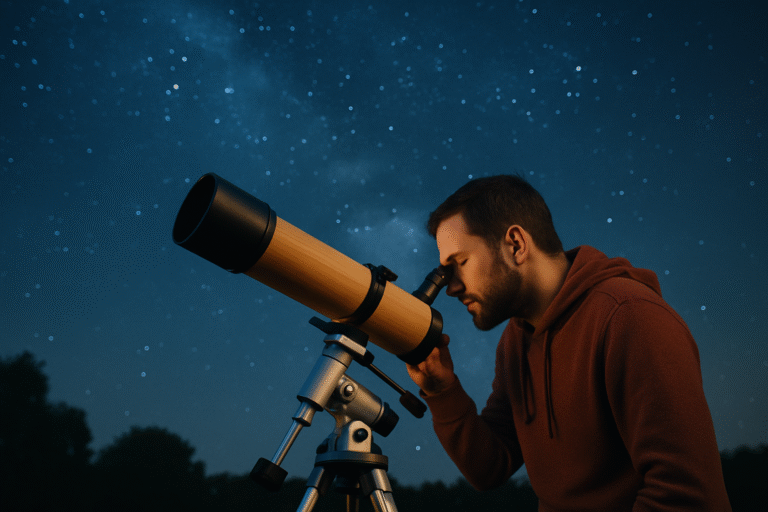
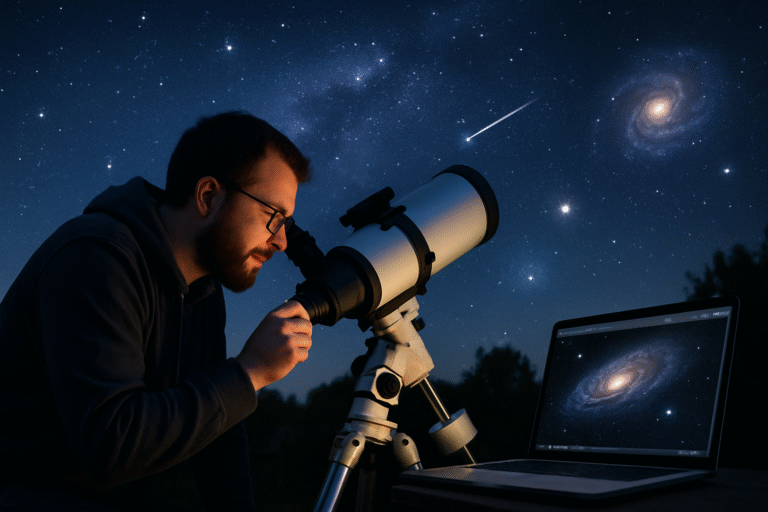
On a clear summer night, the sky above a quiet suburban street transformed into a tapestry of light. A single point of bright white stood out against the velvet black-Jupiter, glowing like a distant lighthouse. With a friend’s beginner telescope mounted on a lightweight tripod, I peered into the eyepiece and gasped at the banded clouds swirling around that distant world. That first glimpse of another planet, suspended hundreds of millions of miles away, sparked something elemental: curiosity about the vast cosmic ocean that surrounds our fragile blue dot.
Cosmic curiosity is part wonder and part playful investigation. It can start with a simple question-How far away is that star? Why does time feel different near a black hole?-and then grow into months or even years of exploration. It doesn’t require a doctorate or a high-powered observatory. With an open mind, a few basic tools, and a willingness to be surprised, anyone can dive into the mysteries of space and time.
Imagine charting the motion of Jupiter’s four largest moons as they dance around the gas giant, each complete orbit a cycle of shadow and light that you can time with a smartphone app. Or holding a diffraction grating film in front of your eye to split starlight into a rainbow, revealing telltale emission lines that hint at elemental composition. These modest experiments bridge the gap between home and cosmos, letting you touch aspects of astrophysics from your own driveway.
But cosmic curiosity isn’t just about looking through lenses. It extends into the realm of thought experiments. Picture yourself traveling at 99 percent of light speed toward a distant star. You set your clock ticking. According to your onboard chronometer, only a few years pass before you reach your destination, but back on Earth, decades have slipped away. That strange consequence-time dilation-arises directly from Einstein’s special theory of relativity. You don’t need a spaceship to feel its impact; a short thought experiment can unravel the deep connection between space, time, and velocity in your mind.
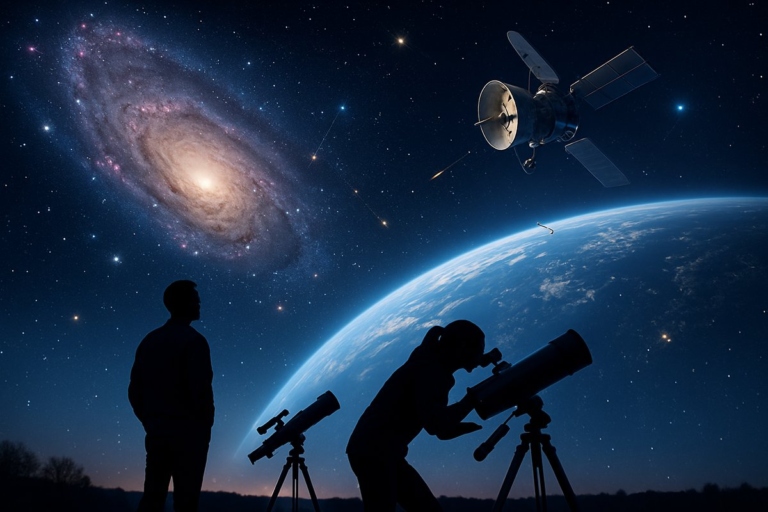
Consider gravitational lensing: the way a massive galaxy cluster warps spacetime so dramatically that distant background galaxies appear stretched, duplicated, or even ringed. A casual newcomer might see odd shapes in a deep-field image and assume digital glitching. In reality, light has curved around a cosmic mass, creating natural “magnifying glasses” that reveal galaxies otherwise too faint to detect. Web-based citizen science platforms invite anyone to sift through these distorted images, tagging features for professional astronomers to analyze. Participation in these projects transforms a passive scroll through space photography into an active search for new phenomena.
For many enthusiasts, cosmic curiosity blossoms into fandom for the grandest observatories of our time. Images from flagship space telescopes showcase nebulae that defy description, with sculpted columns of gas and dust set ablaze by newborn stars. Surveys of the cosmic microwave background whisper of conditions just 380,000 years after the Big Bang, encoded in tiny temperature fluctuations. Each pixel is a chapter in the universe’s story, waiting for an inquisitive reader to decode its secrets.
Yet the journey need not be exclusively visual. Sound artists-sometimes called sonifiers-have turned radio wave data from planets and pulsars into eerie musical compositions. You can listen to the rhythmic pulses of a rotating neutron star converted into MIDI notes, or the whoosh of solar wind interactions morphed into ambient soundscapes. By engaging multiple senses, these creators highlight the poetic side of data: the hidden melodies of magnetospheres and the staccato beats of cosmic rays hitting detectors.
The physical world also offers tactile ways to connect with the cosmos. Meteorite fragments-small, polished slices of iron-nickel alloy-can fit in the palm of your hand. Holding one is like grasping a piece of the early solar system, preserved through billions of years of interstellar travel. Mineral and crystal enthusiasts marvel at meteorites’ Widmanstätten patterns, those intricate, crosshatched metal structures that only form under ultra-slow cooling deep inside an ancient parent body.
Cosmic curiosity often leads people outdoors for communal stargazing events. Amateur astronomy clubs host monthly meetups in dark-sky parks, where dozens of telescopes point skyward in synchronized enthusiasm. Beginners learn to identify constellations, seasoned observers compare eyepieces, and instructors demonstrate sky-mapping apps that overlay real-time star fields on a phone’s screen. These gatherings blend scientific rigor with social connection, reminding us that curiosity flourishes in community.
Underpinning all these activities is a nurturing of sustainability and emotional intelligence. By contemplating the sheer scale and fragility of our cosmic home, observers often emerge with a renewed sense of responsibility toward Earth’s environment. The same perspective that reveals our planet as a tiny dot encourages climate-conscious choices in daily life. Moreover, the practice of observation-patiently waiting for the right moment to catch a transit or align a telescope-cultivates mindfulness and emotional wellbeing.
Space art and creative writing also provide avenues for cosmic exploration. Amateur artists paint nebula-inspired canvases using fluorescent pigments, capturing the interplay of ultraviolet and visible light. Poets craft odes to dark matter, pondering its unseen presence that shapes galaxies like a cosmic scaffold. Writers propose fictional dialogues between photons and gravity waves, weaving surreal conversations that humanize the abstractions of physics.
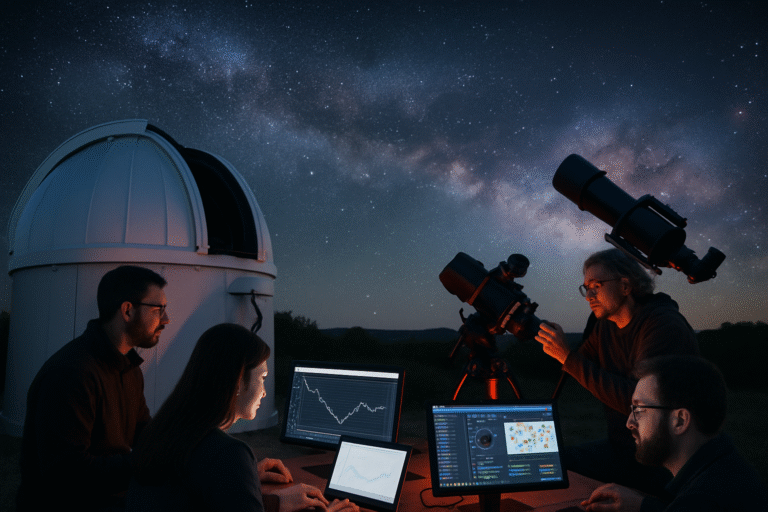
If cosmic curiosity has a future, it lies in hybrid experiences that merge physical exploration, digital interactivity, and community-driven science. Augmented-reality apps will overlay real-time telescope feeds onto your surroundings, letting you “see” the moons of Mars as if they hovered above your coffee table. Virtual-reality installations will transport you inside a supernova remnant or along a cruise path past Saturn’s rings. And global networks of backyard telescopes, linked via online platforms, will pool data to detect near-Earth asteroids-turning amateur stargazers into planetary defenders.
Above all, the true magic of cosmic curiosity comes from asking open-ended questions and embracing uncertainty. Whether you’re baffled by quantum entanglement or the origin of cosmic voids, each question is a door into deeper wonder. The universe doesn’t hand out easy answers. Instead, it offers a dialogue that unfolds gradually, inviting persistent explorers to return night after night, thought experiment after thought experiment, image after image.
So the next time you step outside and look up, remember that the pinpricks of light overhead are more than decoration. They are sources of profound insight and playful discovery. From simple star charts and entry-level telescopes to advanced data sonification tools and citizen science platforms, the cosmos stands ready to reward your curiosity. All it takes is a spark of wonder and the humility to let the unknown in.
May your journey through space and time be guided by questions that delight as much as they educate. And may each new fact you uncover serve as a reminder that, in the expansive cosmic seas, the most exhilarating voyage is the one fueled by your own boundless curiosity.