Location
Mount Vernon, WA 98274
Location
Mount Vernon, WA 98274


In a move that blends red tape with rip-roaring ridicule, the Federal Humor Authority now mandates citizens to secure official laugh permits before indulging in spontaneous giggles. The measure, designed to "ensure equitable giggle distribution," has sparked street protests, midnight comedy workshops and an underground movement dubbed "Free the Chuckle."
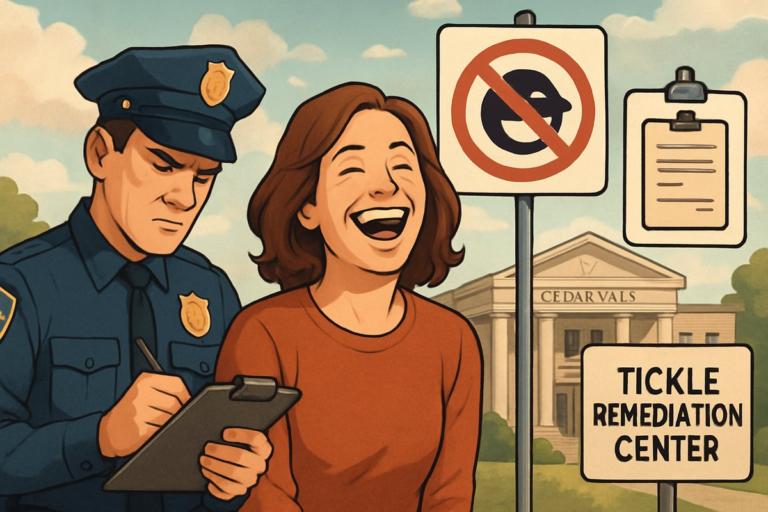
In a development that has left stand-up comics, toddlers and late-night snackers equally exasperated, the newly formed Federal Humor Authority (FHA) announced yesterday that every burst of spontaneous laughter must now be backed by an approved Laughing License. Officials insist the measure is necessary to curb “unregulated chuckle inflation” and to redistribute comedic currency across demographic groups. Citizens can apply online through the FHA’s Portal of Official Mirth, a sleek website that looks suspiciously like any other tax-filing gateway except it features rotating GIFs of cats in bow ties.
Residents of Crestwood City discovered the hard way that unlicensed laughter triggers automated compliance alerts. City Hall reported that during last night’s big game, at least 37 people received infrared notifications from drones hovering overhead: “CEASE UNAUTHORIZED CHUCKLING OR FACE A MANDATORY GAG ORDER.” Panic ensued when a technically gifted octogenarian tried to debug the drone feed using his vintage ham radio.
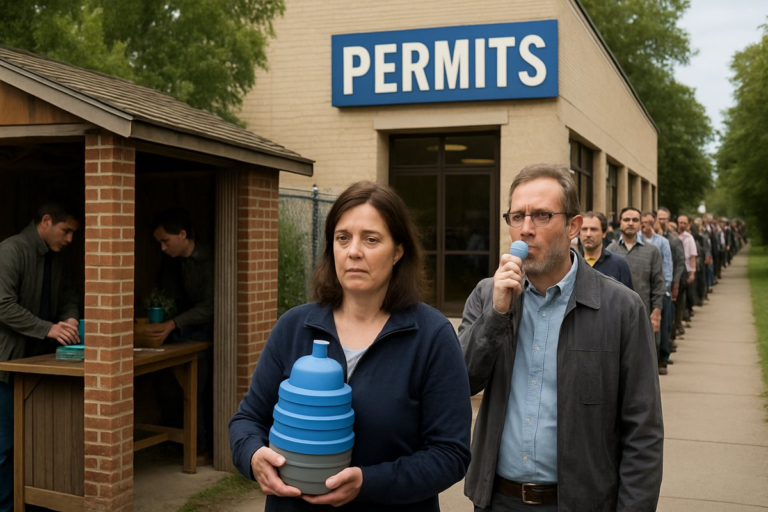
The new licensing structure comes in three tiers: Tier 1 covers a polite snicker or an involuntary snort, Tier 2 covers hearty guffaws and contagious cackles, and Tier 3-available only by invitation-covers riotous belly laughs that can induce nosebleeds. Tier 1 applications require a 12-page form documenting past laughter history and at least two character references who can vouch for your comedic tendencies. Tier 2 involves an additional fee, a digital fingerprint scan, and proof of emotional intelligence from a licensed therapist. Only government-certified Humor Officers can approve Tier 3 entries after a rigorous trial featuring knock-knock jokes, puns and at least one elaborate prop gag.
Local community centers have sprung up to help applicants prepare. The “Giggly Prep Institute” in Midvale County advertises crash courses on the difference between a polite chortle and a full-blown cackle. “There’s a fine line between ‘safe to chuckle’ and ‘federal offense,'” explains instructor Marlene Chong, waving a whiteboard met with half-smiles from a dozen attentive students. Each class ends with a mock FHA exam: students must produce an original ten-second laugh sequence under timed conditions.
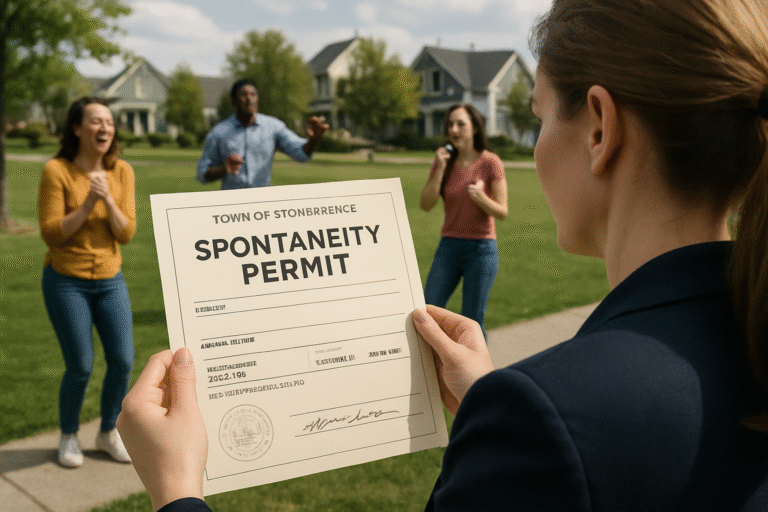
Critics argue the policy is an absurd overreach that targets the one universal human response left unmonetized. “Breathing is free, blinking is free, but now even humor has a price tag,” says community activist Marco Petrov on a local radio broadcast. He leads the grassroots coalition “Free the Chuckle,” which has staged impromptu flash-mob laughs in public squares. The FHA responded by issuing cease-and-desist subpoenas to anyone involved in unauthorized group mirth, though the legal team admitted they’re still drafting a definition for “group mirth.”
Meanwhile, a coalition of quantum physicists and stand-up comedians has pointed out a cosmic irony: if laughter causes positive energy waves, then regulating it could disturb space-time equilibrium. Dr. Aisha Rahman, a theoretical humorologist, warns that suppressing giggles could create a ripple effect strong enough to collapse a dimension where punchlines go unheard. In an open letter to the FHA, she demands a “Laughter Impact Assessment” before any further enforcement powers are granted.
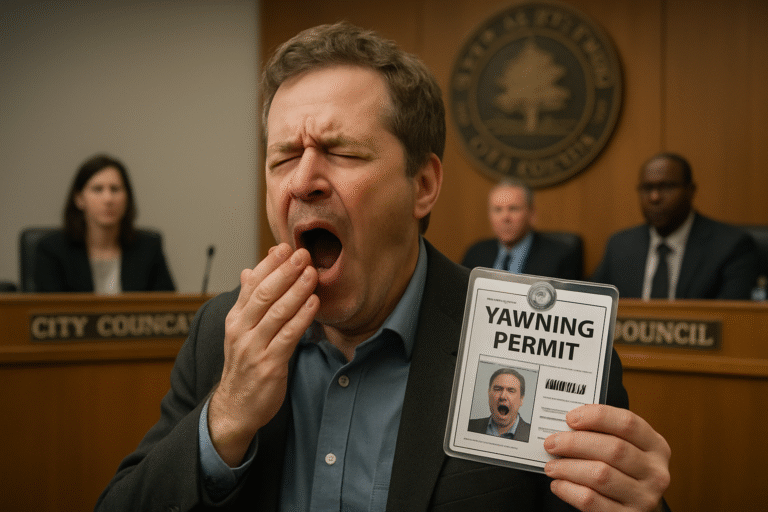
In a surprising turn, the FHA announced plans to deploy an AI-driven Isotope of Irony Detector. This quantum device allegedly scans ambient giggle patterns and flags infractions in real time. The headquarters of the FHA unveiled it at a press conference, where a robotic voice intoned, “Unauthorized mirth detected at 0.7 giggle units per second-please present your Laughing License.” Audience members later complained that the device’s monotone droning nearly induced spontaneous yawns instead of laughs.
Rural towns aren’t immune. Last week, Pinevale Township discovered that several dozen chickens had violated noise ordinances by laying eggs while clucking-or what the FHA deems “poultry giggles.” Livestock owners now must register their flocks under a subcategory license called Barnyard Belly Laughs. One exasperated farmer described his predicament: “I have to schedule my chickens’ comedic routines or risk a $250 fine. Is nothing sacred?”
Online debate has erupted into threads with titles like “Do I Need a Laughing License to Watch Cat Videos?” and “Emergency Permit for Streaming Comedy at 2 AM?” Answers vary wildly. The FHA’s FAQ insists that users streaming prerecorded jokes must secure a Digital Comedy Permit, while live streams require a Virtual Chuckle Pass. All content is subject to random audits by a team of sarcasm analysts.
Tech companies are already marketing solutions. One startup offers a “Laugh-Lock” smartphone app that mutes your device when your laugh threshold is exceeded. Another sells “Compliance-Ready Emoji Packs” designed to convey a pretend chuckle without actually triggering enforcement. Meanwhile, a group of enterprising lawyers advertises “Canned Laughter Defense Kits” for those caught without a license during a crisis dinner party or high-stakes board meeting.
Amid the uproar, a small miracle of human creativity emerged. Inport, a remote island nation with a population of 142, declared itself an independent Laughter Sovereignty Zone. It now issues its own “Inportian Chuckle Charters” that migrants can affix to their passports. Tourists arriving in Inport are greeted with a free welcome laugh and reminded that the only crime there is taking amusement, well, too seriously.
For many citizens, the humor now is in resisting the regulation itself. Secret underground laughter clubs have popped up, featuring password-protected open-mic nights and clandestine joke scribes selling illicit one-liners on paper ballots. One such venue, The Giggle Cellar, requires attendees to whisper their punchlines into a hollowed-out cucumber before performing in total darkness.
As the first wave of license renewals approaches, the nation finds itself at a crossroads between regulated hilarity and unfettered joy. The FHA maintains its stance, arguing that centralized oversight will create “a more equitable comedic ecosystem.” Protestors counter that humor thrives best when it’s organic, spontaneous and entirely unregulated. Meanwhile, the rest of the world watches and wonders: will this be remembered as the era when laughter learned to stand in line, or the moment citizens finally cried uncle-and then laughed about it?
Whatever the outcome, one thing is certain: citizens everywhere are brushing up on knock-knock jokes, perfecting their silent chuckles and keeping a close eye on their expiration dates. After all, in these bureaucratic times, the best defense might just be an approved smile.