Location
Mount Vernon, WA 98274
Location
Mount Vernon, WA 98274

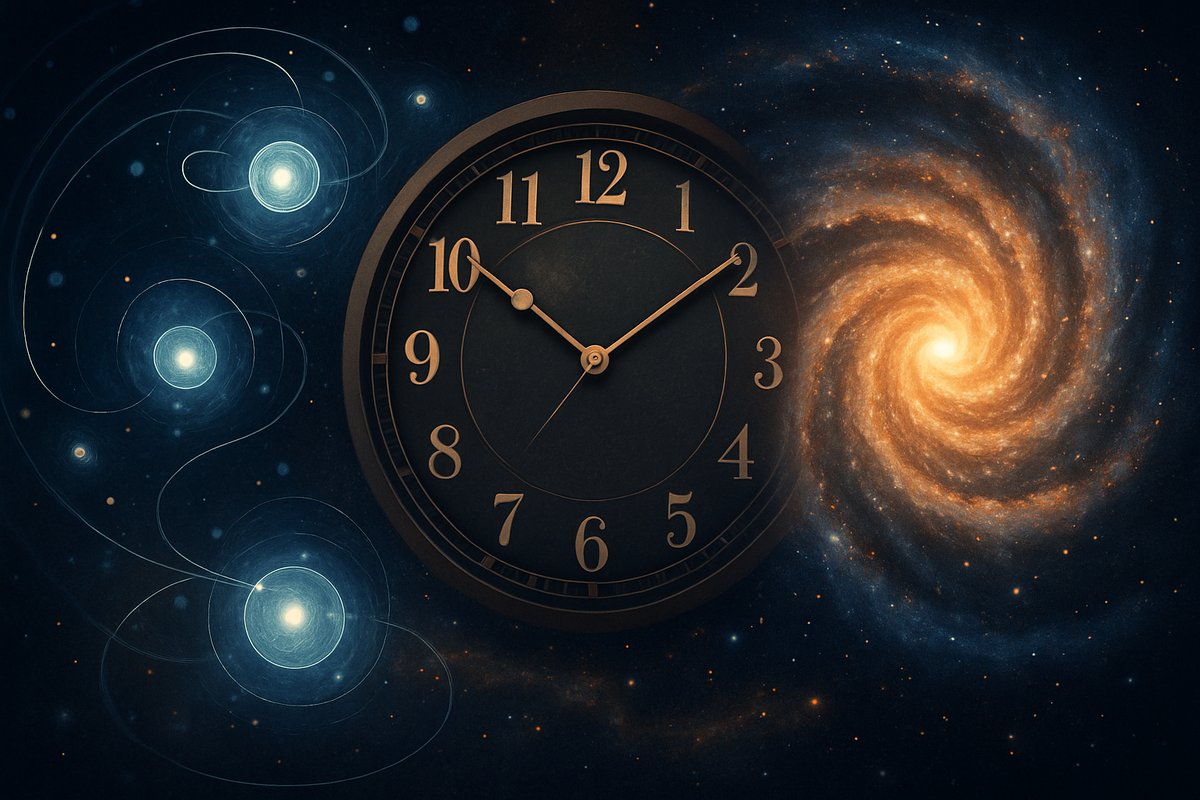
From the flicker of quantum particles to the sweep of galaxies, our universe tells a story of unfolding mysteries. By tracing the dance of time, mass, and entropy, we uncover how the cosmos shapes our perceptions, dreams, and daily lives.
At the edge of human inquiry lies a tapestry spun from threads of time, woven with strands of matter, and embroidered by the ever-present pull of mystery. Every moment we breathe carries the imprint of ancient cosmic events-the fusion of hydrogen in distant stars, the subtle shift of a neutrino crossing light-years of vacuum, the inexorable march of entropy that transforms order into chaos. In this exploration, we trace how the fundamental ingredients of reality inform not only the architecture of the universe but also the narratives we craft about our own place within it.
Imagine standing beneath a dark sky, far from city lights, and watching the faint glow of the Milky Way stretch overhead. That luminous band is more than a scenic backdrop-it is a living chronicle of stellar life cycles. For billions of years, hydrogen atoms have fused into helium in stellar cores, releasing energy that travels outward as photons. Some of those photons reach our eyes tonight, carrying with them the fingerprint of nuclear processes that began in an era before there was even an Earth. This journey of light is a journey through time itself, a reminder that looking upward is equivalent to looking backward.
Shift now from the grandeur of galaxies to the intimate realm of quantum fields. Here, particles blink in and out of existence, governed by probability waves and a set of rules that defy everyday intuition. Time in this realm is not a smooth river but a frothing flux of indeterminate events. A single electron might tunnel through a barrier that classical physics forbids, or a virtual pair of particles may briefly emerge from the vacuum before annihilating one another. These microcosmic antics contribute to everything from the stability of atoms to the way modern electronics function. In quantum mechanics, matter is a tapestry of possibility, and time is the loom upon which that tapestry is woven.
Connecting these scales is the principle of mass-energy equivalence, which underpins both the nuclear reactions in stars and the inner workings of particle accelerators. In the heart of a collider, stray protons are hurled close to the speed of light, colliding with enough energy to briefly manifest heavier particles. Each collision is a microcosm of creation and decay, echoing the processes that forged the elements during the universe’s infancy. That same energy release powers technologies we rely on today, from medical imaging to the study of materials. Mass and energy stand in perpetual exchange, shaping the cycles of birth, transformation, and farewell that define both atoms and ideas.
But another thread runs through the fabric of existence: entropy. Often misunderstood as mere disorder, entropy is better seen as a measure of the number of ways a system can arrange itself. A well-ordered crystal has low entropy because its constituents occupy a limited set of positions. A hot gas in a box has high entropy because molecules can roam freely in countless configurations. The Second Law of Thermodynamics dictates that, in a closed system, total entropy never decreases. This arrow of time gives our experiences a clear direction-from past to future, from simpler arrangements to more complex dispersals of energy.
Entropy’s influence extends to the birth of stars, the evolution of black holes, and the eventual fate of the cosmos. As gas clouds collapse under gravity, they radiate heat and shed energy, increasing the universe’s overall entropy. The cosmic microwave background-an afterglow of the hot, dense early universe-carries imprints of those entropy shifts, mapping temperature variations that seeded galaxy formation. On a human scale, entropy manifests in aging bodies, in the slow churn of ecosystems, and in the way memories form and fade. Each recollection is an act of local entropy reduction, conjuring order from the randomness of synaptic firings.
Our awareness of time’s arrow shapes cultures, philosophies, and personal narratives. Ancient civilizations marked seasons with solstices and equinoxes, embedding cosmic rhythms into rituals. Philosophers from many traditions have pondered the tension between a predetermined cosmos and the freedom of human choice. Is time a flowing river or an unchanging block, where past, present, and future coexist? Modern physics offers competing viewpoints. In relativity, time intertwines with space into a four-dimensional continuum. In quantum gravity theories, time itself may emerge from deeper entanglements. The boundary between the tangible and the conceptual grows ever more subtle, inviting us to question what we mean when we say “now.”
Consider, for a moment, an astronomer at a remote observatory, calibrating a camera for the first deep-sky exposures of the night. Each shutter click captures photons that began their journey millions of years ago, carrying tales from the farthest reaches of spacetime. Those images become raw data-arrays of numbers that scientists process to detect exoplanets, map dark matter, and measure cosmic expansion. Behind each breakthrough stands a mosaic of individual efforts: engineers designing precision optics, theorists refining mathematical frameworks, data scientists scripting algorithms to sift signals from noise.
Yet the physical truths uncovered by these endeavors resonate deeply with our daily lives. The same detectors that spot distant quasars monitor pollution in urban air. The computational methods born in astrophysics power advances in weather forecasting and financial modeling. Even the poetic notion that we are made of “star stuff” underscores an emotional truth: our bodies carry atoms that were once part of supernovas, forging a lineage that traces back to the universe’s grandest events.
This convergence of the cosmic and the personal underscores a fundamental mystery: why does consciousness arise at all? Out of all the complexity that unfolded since the Big Bang, life emerged on a tiny blue planet and developed the capacity to reflect on its own existence. Neuroscience explores the brain’s networks, mapping how billions of neurons coordinate to produce perception. But a full understanding of subjective experience remains elusive, a frontier where science meets philosophy. Is consciousness a mere byproduct of physical interactions, or does it point toward principles we have yet to grasp?
Even as we confront these enigmas, the very act of questioning binds science to story. We narrate the cosmos in terms of origin myths, creation sagas, and destiny tales. We lay down metaphors-time as a river, the universe as a clockwork, the mind as a mirror-to make sense of phenomena that exceed direct experience. Yet those metaphors evolve with each discovery. When gravitational waves were detected, ripples in spacetime became a new metaphor for connectivity. When neutrinos from a distant supernova arrived days before visible light, they rewrote our understanding of stellar processes.
At its heart, the interplay of time, matter, and mystery invites wonder. It teaches us that the universe is neither a static backdrop nor a simple mechanism. It is a dynamic, evolving narrative in which we are both characters and authors. Each experiment, each observation, each creative leap adds a chapter. And with every chapter, we refine our map of reality, even as new territories of uncertainty beckon.
So next time you pause to watch the sunset, remember that the colors painting the sky result from photons scattered by atoms in our atmosphere-atoms born in ancient supernovae. When you feel the weight of seconds passing, recall that your heartbeat ticks within a vessel hurtling through space on an orbit that has turned billions of times since Earth’s formation. And when you confront life’s uncertainties-its joys, losses, and paradoxes-recognize that you are tracing the same line of inquiry that guides telescopes, particle colliders, and theoretical equations: a profound inquiry into what it means to exist.
In embracing time, mass, and mystery, we do more than study the universe; we inhabit it. We become conscious threads in the cosmic tapestry, weaving our own stories of exploration, curiosity, and meaning. And in doing so, we honor the grand narrative that began with a singularity and continues in every moment of discovery.