Location
Mount Vernon, WA 98274
Location
Mount Vernon, WA 98274

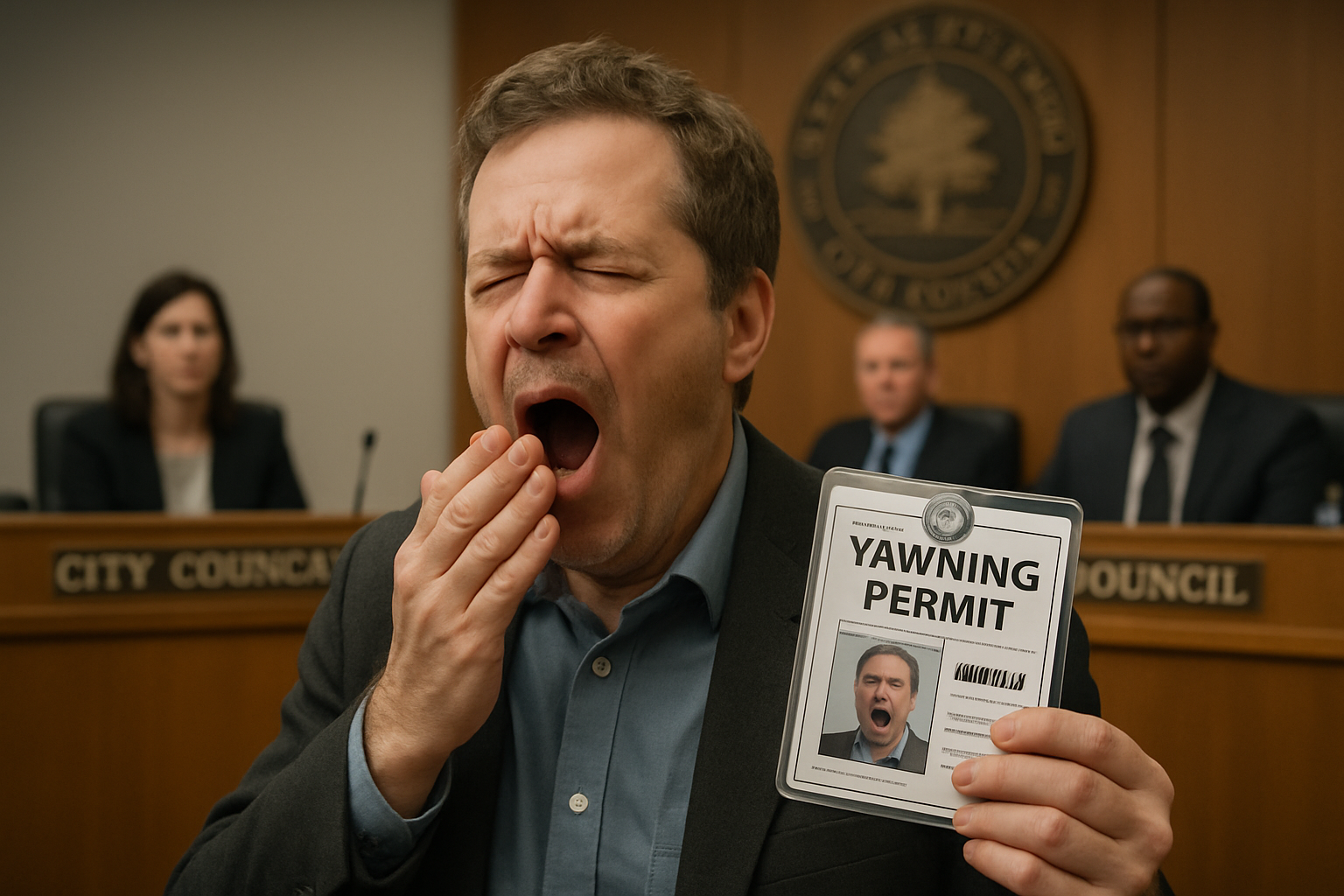
In a move that has citizens both yawning and fuming, the Maplewood City Council has enacted a law requiring residents to secure monthly yawning permits. Officials say the measure protects public safety-while critics accuse them of micromanaging involuntary human biology.
In a landmark session that lasted just long enough to induce a dozen unlicensed yawns among attendees, the Maplewood City Council unanimously approved Ordinance 47-B, mandating that every resident obtain a Yawning Permit before performing what lawmakers now classify as a “regulated involuntary action.” Under the new rule, individuals must apply online or via mail, pay a nonrefundable application fee, and receive an official sticker that counts their monthly yawn quota. Those caught yawning without authorization face fines starting at twenty-five dollars.
“Yawning isn’t just a sign of boredom; it’s a public safety issue,” declared Councilmember Diane Crisp at the unveiling ceremony. Crisp cited a recently published municipal report claiming that unmanaged yawns contributed to 12 percent of minor fender benders in the past year. “We need to manage these micro-disruptions before they spiral out of control,” she argued, brandishing a stack of freshly printed permit stickers.
Implementation will begin next month when the newly formed Yawn Licensing Authority opens its application portal. Each permit grants the holder seventy-two authorized yawns per thirty days-just enough to survive an average workday plus one Friday afternoon town hall. Permit holders are encouraged to log each yawn into the official smartphone app, YAWNometer, which vibrates gently at sixty yawns to warn users they’re approaching their limit.
Not everyone is convinced this is sensible governance. At the downtown farmers’ market, shoppers exchanged incredulous glances as a permit enforcement officer serenely measured the distance between customers’ open mouths. Retiree Helen Navarro, who was waiting in line for coffee, rolled her eyes. “So now I have to pay to yawn? Next they’ll sell us licenses to breathe,” she grumbled, clutching her tote bag. Navarro says she yawned involuntarily during her granddaughter’s recital last week-an act she suspects could have earned her a ticket if officers had been on patrol.
In response to public backlash, a grassroots movement known as Free the Yawn has sprung up across social media. On the hashtag #FreeTheYawn, activists share photos of wide-open mouths and mock permit stickers. One viral post features a toddler snoring through nap time with the caption, “Unlicensed Yawns: Childhood Right or Crime?” The group plans a demonstration next Saturday near City Hall, urging officials to repeal the ordinance in the name of bodily autonomy and unregulated respiration.
Council allies argue the crackdown on yawning is no different from existing regulations on other actions that carry public risk-speaking above a whisper in a library, jaywalking, or even juggling in crowded pedestrian zones. “We regulate all sorts of things that used to be considered harmless,” said municipal attorney Graham Eddings. “Yawning can spread contagions. It can distract drivers. It’s common sense to treat it with the same seriousness as any other public nuisance.”
Meanwhile, local entrepreneurs have seized the opportunity to profit from Maplewood’s newfound yawn vigilance. At Bean & Steam Café, a pop-up kiosk offers “pre-authorized yawn credits” for those who expect to blow past their monthly limit. For five dollars, customers receive a token redeemable for one extra yawn-scanned on a handheld device by baristas sporting YLA badges. “We’re just giving people the flexibility they need,” said café owner Marcus Lee, stirring a vat of energy-shot espresso. “And it pairs nicely with our new espresso-infused gum.”
A darker side of the market has also emerged. Reports of counterfeit stickers and black-market yawn quotas have flooded the YLA hotline. A tip led authorities to a clandestine basement operation where a ring of bootleggers printed unauthorized permit decals. They even offered night-vision goggles to help cover illegal yawns under the cover of darkness. After five arrests, the YLA warned citizens against participating in these schemes, reminding them that even “unauthorized yawns” are subject to enforcement.
Teachers in the Maplewood School District are scrambling to adapt. The new policy requires students to file yawn requests at least twenty-four hours in advance. Mrs. Patel’s fifth-grade class spent last Tuesday crafting formal yawning petitions complete with parent signatures and medical documentation for any extraordinary yawns. “I’ve never seen so much red tape over a simple stretch of the mouth,” Patel lamented. Some educators fear the ordinance will stifle classroom engagement and penalize kids for typical signs of fatigue.
At the Maplewood Senior Center, volunteers have set up a makeshift “Yawn Station,” complete with rocking chairs and community guidelines posted on the wall. Seniors can gather at designated times to exercise their yawning rights in groups, thereby distributing quota usage evenly. “It’s the only peaceful place left where I can yawn freely,” said retiree George Simmons. “My doctor says yawning helps circulation. Now I feel like a criminal for taking care of my health.”
City officials maintain they’re listening to feedback. A mid-ordinance review is scheduled for next quarter to evaluate the program’s impact on public safety, productivity, and overall quality of life. Meanwhile, speculation is rife that neighboring towns are eyeing Maplewood’s approach. “We could become trendsetters for the region,” brags Councilmember Crisp. She hints that future ordinances might regulate sneezing, eye-rolling, or even that infamous Maplewood face-palm.
In a final ironic twist, a group of local researchers from the Maplewood Institute of Technology is developing a virtual reality yawning simulator. Rather than use up permit quotas, citizens could don a VR headset in public spaces to experience a simulated yawn-complete with ambient sounds and haptic feedback. If approved, this innovation might render actual yawns obsolete. For now, Maplewood residents must decide whether to comply, protest, or invest in one of the city’s new yawn-credit side hustles.