Location
Mount Vernon, WA 98274
Location
Mount Vernon, WA 98274

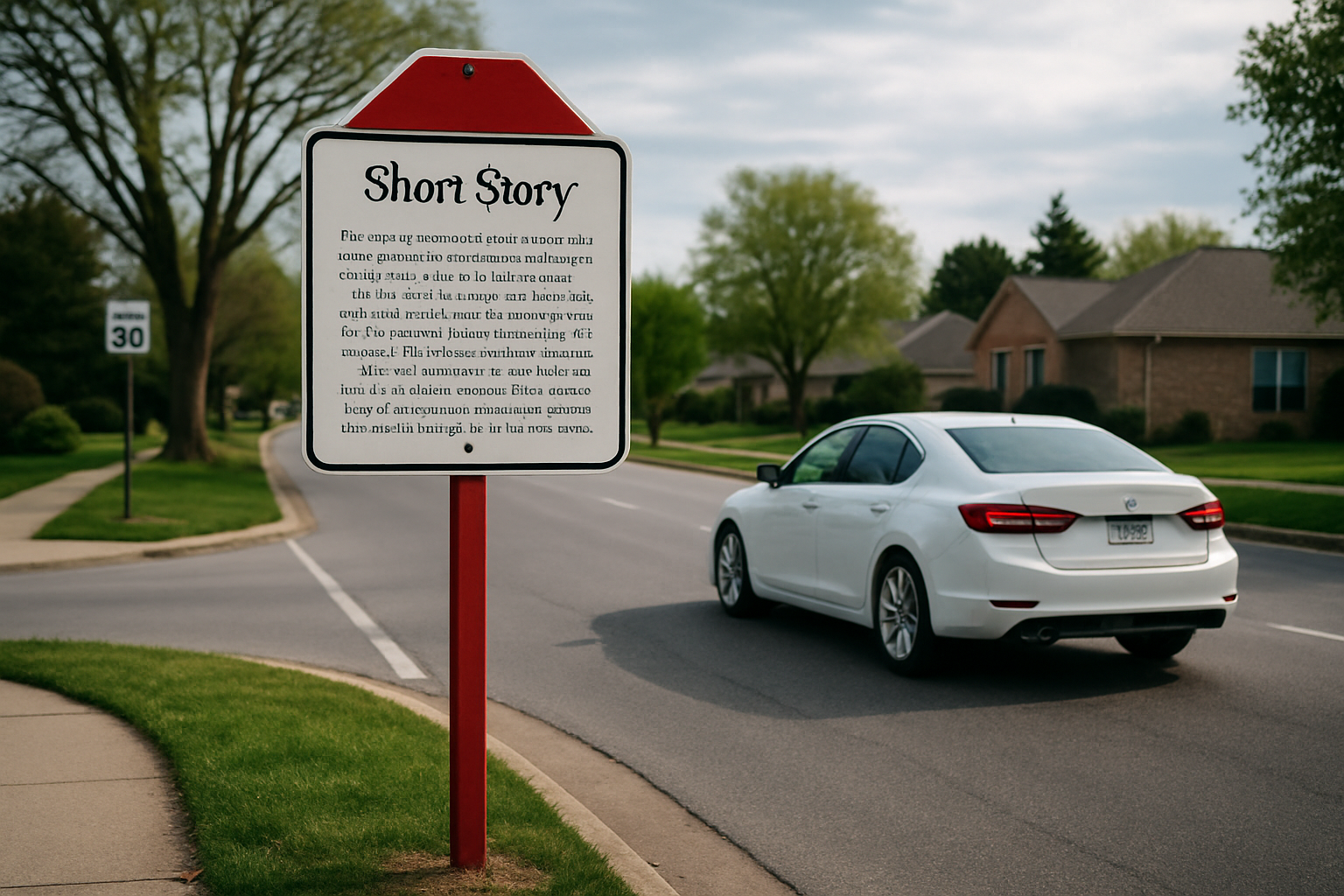
In an unprecedented move, the city council of Litfork has swapped every stop sign and speed limit marker for custom short-story panels. Drivers are now stopping not just for safety but also for suspense, tragedy, and occasional bad poetry. The project has sparked delight, frustration, and a budding roadside literature scene.
When the Litfork City Council convened last month to address “driver engagement and community spirit,” few expected the result to be a fleet of traffic signs printed with original fiction. Yet on Monday morning, Main Avenue commuters encountered their first hurdle: a stop sign recast as a 150-word micro-drama about a runaway trolley that ultimately hires a life coach.
By midday, the town’s back roads were lined with panels featuring gothic suspense, slice-of-life comedy, and the occasional haiku lamenting mechanics’ shop hours. Speed limit warnings dovetailed with tales of wayward hamsters navigating labyrinthine drains. The initiative-dubbed the Narrative Road Project-was pitched as a way to reduce distracted driving by turning mundane travel into a shared cultural experience.
City Manager Petra Delgado, the architect behind the plan, said organizers conducted focus groups with drivers who admitted to scrolling through social media at red lights. “We wanted to channel that impulse into something locally created,” Delgado explained. “Now you’ll see your neighbor’s latest memoir excerpt instead of an ad for streaming services.”
Early reactions ranged from unbridled enthusiasm to near-panic. Book club members formed caravans, reading aloud from crosswalk curb to curb. Children chased clues in mystery-themed speed signs, convinced a treasure trove lay at the next intersection. Meanwhile, commuters clutching steering wheels muttered complaints about cliffhangers mid-turn.
Local safety advocates have raised alarms that drivers are too preoccupied to notice pedestrians stepping off curbs. “We appreciate art as much as anyone,” said Patrol Lieutenant Marlon Reeves, “but when folks are racing to find out if the protagonist survives, they forget to hit the brakes.” He reported a 22 percent spike in near-misses at literary-themed junctions.
Traffic engineers have offered technological workarounds. A coalition of local high-schoolers installed temporary motion sensors that trigger audio narrations of sign content, allowing drivers to glance at the road rather than reading every word. The so-called “EarLit Kits” have popped up on four lanes of South Elm, with sound levels calibrated to cut off at 35 decibels to avoid disturbing nearby homes.
Not everyone is on board. The Minimalist Road Coalition-an informal group of commuters yearning for plain white-on-red signs-handed out petitions demanding a rollback. Their slogan, “Stop Signs, Not Stop Lines,” has been graffitied on lamp posts around town. Coalition leader Dana Harrow warned that the narrative takeover could spread to yield signs, toll booths, even digital billboards commandeered for chapter breaks.
By Thursday, a black-market for spoiler alerts had emerged. Drivers would huddle at bus stops, trading whispers about plot twists ahead. A local barista reported a surge in clandestine caffeine runs at junctions where the latest horror vignette was printed. “They’re jittery about what happens next,” she said while pouring double-shots for jittery patrons.
Coffee shops have happily capitalized on the craze. One café on Maple Lane advertises a “Cliffhanger Combo”: a latte paired with a 50-cent summary of the road sign story in progress. Nearby bakeries have rolled out “Plot Twist Pies” topped with flaky pastry pages that dissolve in milk. The aroma of cinnamon and betrayal wafts through the morning rush.
Meanwhile, roadside book exchanges have migrated from bus shelters to the medians. Drivers toss back pocket editions to replace read volumes-sometimes flinging them from passenger windows. Recycling crews now collect stacks of discarded story panels each evening, hoping to salvage pages for compost rather than landfill.
Perhaps most perplexing are the unlicensed fiction distributors. At unofficial signposts planted in cul-de-sacs, local poets hawk seat-of-their-pants narratives in exchange for tips or handwritten haikus commemorating your trip. One enterprising teenager, who calls himself “Chapter One,” has started charging drivers to submit their morning commute anecdotes as short-story pitches.
Town Council meetings have become theatrical events. Public comment periods alternate between policy arguments and open mic readings. Last week, an elderly resident recited a monologue about her missing cat-delivered in iambic pentameter-before demanding the panel install dog-themed thrillers. Another attendee demonstrated a live reenactment of a dystopian tale set at the five-way intersection downtown.
In response to safety concerns, the council introduced “Flash Summary Beacons”-LED lights that signal when a sign’s prose exceeds 120 words. The lights turn red for overlong passages and drivers are instructed to pull over at designated “Reading Bays” to finish the text. These bays, painted like library reading rooms, feature benches, book stands, and a strictly enforced two-minute time limit.
Commuter sentiment remains divided. Taxi driver Lucia Mendes said she loves the change. “I give two-minute soliloquies to my riders at every signal. It’s like performance art in gridlock.” By contrast, paramedic Andre Nguyen reported arriving late to several calls after getting caught in a volunteer road-side book club discussing a particularly twisty tragedy.
Amid the chaos, local schools have seized the moment. Fourth graders are composing their own six-sentence stories intended for upcoming sign replacements. The high school’s creative writing class has been tasked with producing weekly installments for the downtown corridor. Administrators hope this real-world outlet will inspire future authors-and reduce weekday mischief.
An unexpected side effect: increased civic engagement. Voter registration booths now sport free story postcards, and debates over which genres should dominate next season bring neighbors together. Some are calling it a renaissance of public discourse, others fear it’s a recipe for chaos if fantasy and reality blur too readily on busy highways.
Pet owners have weighed in as well. The Pet Lovers’ Roundtable proposed cat mystery series along the leafy byways, claiming drivers would appreciate tales of daring felines. The Avian Appreciation Society countered with parables starring heroic sparrows. Factions are forming; neighborhood signs could soon read like chapters from a wildlife documentary gone rogue.
Amid the ongoing skirmishes, a traveling poet laureate passed through town and staged a pop-up “Epic Poem Intersection.” Drivers waited forty minutes for a three-line verse about existential potholes. Local news dubbed it “the slowest traffic jam ever to achieve artistic acclaim.”
For now, the pilot phase of the Narrative Road Project remains slated through year’s end. Council members say they’ll assess safety data, community feedback, and litter volumes before deciding whether to extend or revert to standard signage. In a town meeting last night, applause-ironically muted by a sign quoting Nietzsche on the futility of clapping-brought an end to the evening.
Only time will tell if Litfork’s tale-spun streets become a model for other cities or a cautionary legend of well-meaning whimsy gone awry. Until then, residents and visitors alike can look forward to examining every curbside panel, anticipating the next plot twist in their daily commute.