Location
Mount Vernon, WA 98274
Location
Mount Vernon, WA 98274


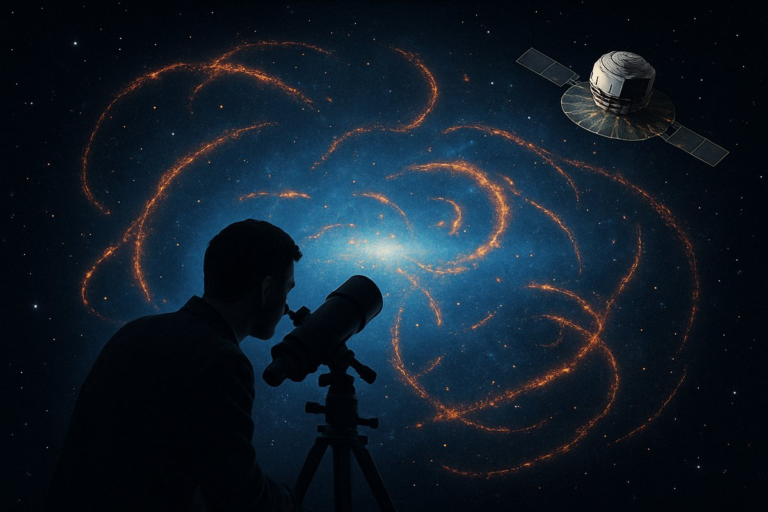
A new era of cosmic mapping and real-time data networks is revealing the universe's hidden contours while raising urgent questions about who watches and who remains unseen. From quantum-encrypted communications beaming across low Earth orbit to AI-driven sensor constellations, the balance between scientific discovery and individual privacy is more precarious than ever.
Humanity stands on the threshold of an age when the very fabric of space-time becomes a canvas for exploration-and surveillance. Advanced sensor arrays, quantum communication links, and edge-computing satellites are converging to produce a lattice of space-time data streams that promise unprecedented insights into cosmic events, gravitational anomalies, and climate shifts. Yet this same lattice carries the potential for tracking movements on Earth with a level of precision once imaginable only in science fiction.
Next-generation cosmic cartography is no longer confined to mapping distant galaxies. Modern missions now aim to chart subtle ripples in space-time, from passing gravitational waves to minute time-dilation effects caused by Earth’s dense mass. Space agencies are deploying fleets of small satellites equipped with atomic clocks and multi-band sensor suites. Their goal is to create a dynamic 3D grid spanning low Earth orbit, where every point in time and every corner of the sky can be timestamped with nanosecond accuracy.
Running in parallel, quantum communication experiments are maturing quickly. Entangled photon sources placed aboard orbiting platforms promise unhackable channels and global time synchronization that defies classical eavesdropping. Trials conducted with ground stations in remote deserts and mountain tops have already demonstrated secure key exchange over thousands of kilometers. If scaled, such networks would allow research teams to collaborate in real time on cosmic phenomena without fear of interception-but they could also shield illicit intercept operations from oversight.
China’s flagship quantum satellite project and Europe’s SpaceNets demonstration program each showed how quantum links can be woven into a broader mesh of interconnected relays. SpaceNets recently tested an onboard AI module capable of routing encrypted payloads through the most efficient orbital paths-cutting latency for data-intensive observations. The same architecture, however, can be repurposed to obscure surveillance traffic, making it harder for regulators to detect unauthorized monitoring of terrestrial and maritime activity.
Meanwhile, private companies are launching constellations designed to observe weather patterns, plate tectonics, and ocean currents in finer detail than ever before. These platforms carry not only imaging sensors but also radio-frequency and infrared detectors that capture communications signals, vehicle heat signatures, and even biometric indicators from the ground. When fused with terrestrial databases, this stream of orbital intelligence can pinpoint individual locations or track large populations during protests, natural disasters, or mass migrations.
Outer space governance remains fragmented. The United Nations Outer Space Treaty sets broad principles-such as using celestial bodies for peaceful purposes-but lacks enforceable norms for privacy protection. Regional pacts and national legislation vary widely on data sovereignty, aerial reconnaissance limits, and proprietary rights to collected orbital imagery. As nations and corporations race to deploy thousands of satellites, questions of jurisdiction blur when data traverses multiple control centers in different countries.
Back on Earth, NASA’s planned Global Space-Time Observatory envisions an open network of sensors and satellites providing continuous monitoring of planetary processes. Advocates highlight benefits for climate science, disaster response, and navigation safety. But privacy experts warn that even anonymized datasets can reveal patterns of everyday life: commuting routes, energy usage at schools and hospitals, or congregation hotspots in urban centers. Once collected and stored, granular location histories can be re-identified through data linking techniques.
The technical challenge of protecting individual privacy in this context is immense. Traditional encryption shields data in transit, but once decrypted for analysis, it becomes vulnerable again. Proposals for homomorphic encryption promise computations on encrypted datasets without exposing raw values, yet the computational overhead remains prohibitive for real-time space networks. Differential privacy techniques can inject statistical noise to obscure personal identifiers, but tuning the balance between data utility and privacy is a delicate task.
Adding to the complexity is the rise of edge AI aboard satellites. By analyzing imagery and sensor readings in orbit, these systems can downlink only high-value targets instead of entire data logs. This reduces bandwidth demands and improves response times for scientific alerts. Yet the same selective filtering can be programmed to prioritize certain geographic regions or demographic profiles, potentially enabling covert surveillance operations beyond legal scrutiny.
Researchers are exploring privacy-aware architectures that combine decentralized ledger technology with smart contracts. Satellites could store metadata about who accessed which data and when, creating an immutable audit trail. Users requesting specific observations would submit credentials that trigger automated compliance checks against global privacy laws. If properly implemented, this distributed governance model could deter unauthorized use-but it relies on transparent code and collective enforcement by a diverse international consortium.
Public perception will play a critical role in shaping the future of space-time networks. Recent surveys in major research hubs indicate strong support for open scientific data, especially in the fields of climate monitoring and disaster relief. At the same time, a growing majority express skepticism toward commercial surveillance satellites. Citizens worry that corporate or state actors might exploit space-based capabilities to monitor labor movements, enforce social credit systems, or hijack geopolitical disputes.
Policymakers face the dual imperative of protecting privacy while fostering innovation. Calls are mounting for an expanded Outer Space Data Convention, one that sets minimum standards for sensor disclosure, data retention limits, and third-party oversight mechanisms. Some propose an independent Space-Time Ombudsman with authority to adjudicate cross-border privacy complaints. Others urge voluntary industry codes of conduct enforced by certification bodies specializing in space ethics.
In research institutions worldwide, interdisciplinary teams of physicists, data scientists, and ethicists are collaborating to draft technical guidelines. These range from sensor-level anonymization protocols to architectural blueprints for quantum-secure telemetry. The ultimate aim is to create a flexible framework that can evolve alongside sensor technologies and geopolitical shifts.
As the invisible threads of the universe become ever more visible, the promise of cosmic discovery must be weighed against the risk of intrusive oversight. Balancing these forces will require transparent governance, robust privacy-preserving technologies, and a shared commitment to keeping the final frontier a realm of wonder-rather than a panopticon in the sky.