Location
Mount Vernon, WA 98274
Location
Mount Vernon, WA 98274


Researchers around the world are probing the deep connections between time's arrow and the dominance of matter over antimatter, while cutting-edge experiments shine light on phenomena that challenge our understanding of reality. From long-baseline neutrino studies to laboratory time crystals, new discoveries promise to reshape our view of the universe's most enduring mysteries.
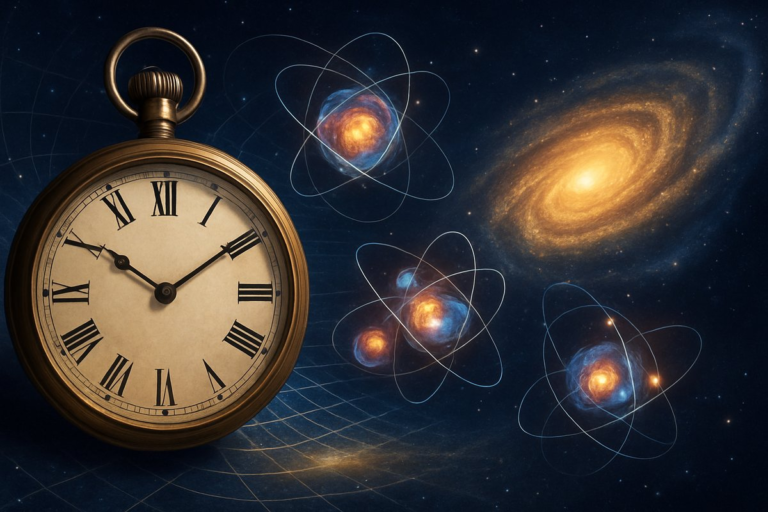
At the dawn of the universe, fractions of a second after the Big Bang, the cosmos underwent transformations that set the stage for everything we see today. Matter emerged victorious over antimatter, enabling stars and galaxies to coalesce. Yet the exact mechanism that tipped the scales remains one of physics’ greatest enigmas. Simultaneously, the directionality of time-why we remember the past but not the future-raises profound questions about the interplay between thermodynamics, quantum mechanics, and gravity. Recent collaborative efforts by international research teams are now converging multiple lines of inquiry, using high-precision particle detectors, advanced atomic clocks, and gravitational wave observatories to explore the shared mysteries of time and matter.
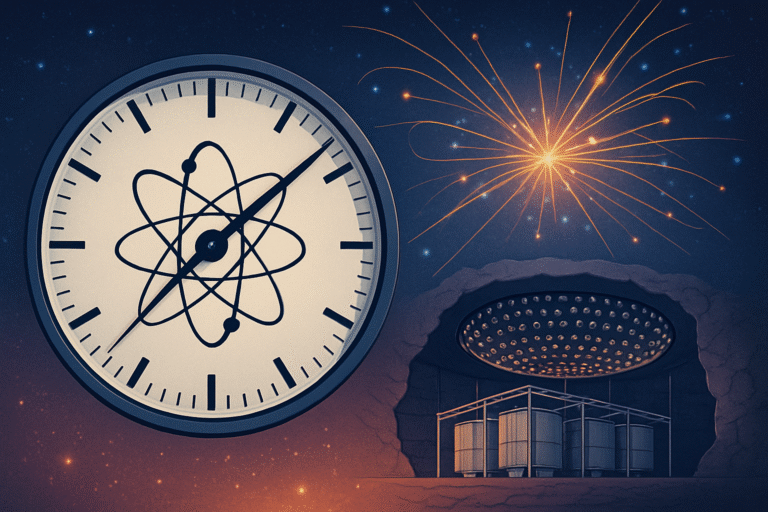
One of the most promising avenues involves long-baseline neutrino experiments, which send nearly massless particles on multi-hundred-kilometer journeys through rock and earth. Neutrinos oscillate between different types as they travel, and subtle differences between neutrinos and their antimatter counterparts-antineutrinos-could reveal the source of the matter-antimatter asymmetry. Scientists operating these detectors report ever-more precise measurements of oscillation parameters, narrowing in on possible charge-parity (CP) violation in the lepton sector. If confirmed, this asymmetry in neutrino behavior would offer a direct glimpse at why the universe favors matter, and could illuminate how time’s arrow emerged from quantum interactions.
Meanwhile, tabletop experiments are tackling the temporal dimension under controlled laboratory conditions. Researchers have built “time crystals,” structures in which particles exhibit periodic motion in time rather than space, defying the expectation that all systems settle into static equilibrium. These time-periodic phases could serve as testbeds for new theories that unify quantum mechanics with an emergent concept of time. By observing how these crystals respond to minute perturbations, teams aim to trace the boundary between reversible quantum laws and the irreversible flow we experience every day.
Elsewhere, ultra-high-precision atomic clocks are being pushed to unprecedented levels of stability, capable of detecting variations in time itself caused by faint gravitational fields or tiny shifts in fundamental constants. Atoms cooled to near absolute zero provide the ticking heart of these devices, and when arranged in an optical lattice, they reveal how time can stretch or compress under different conditions. Such clocks not only promise improvements in global navigation systems and synchronization technologies but also open a window to test whether the laws of physics remain constant across space and time.
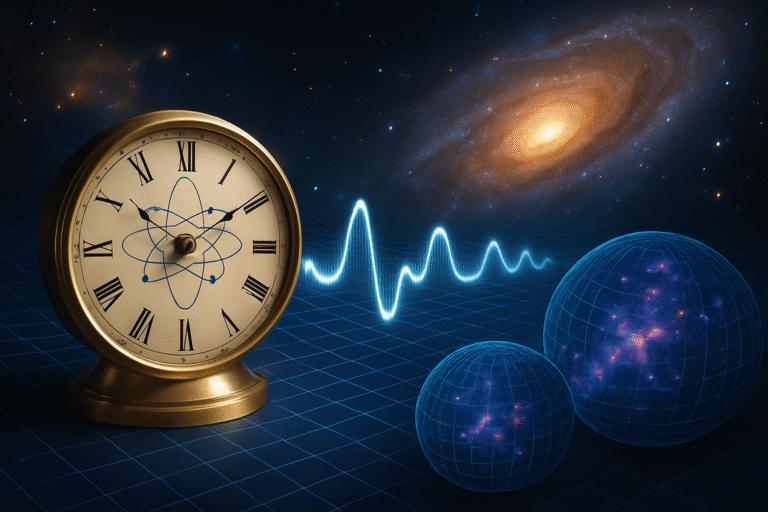
Gravitational wave astronomy has added another dimension to this quest. The ripples in spacetime produced by colliding black holes or neutron stars carry time-dependent signatures that traverse vast cosmic distances. By analyzing the precise waveform of these signals, scientists can infer details about time dilation in extreme gravity, offering windows into regimes where quantum gravity effects might become apparent. Future observatories, both on Earth and in space, aim to capture even subtler events-mergers involving intermediate-mass black holes or primordial relics-potentially revealing new physics at the intersection of matter, energy, and temporal structure.
In parallel, efforts to trap antimatter in magnetic and electric fields have made remarkable strides. Sophisticated traps now hold samples of antiprotons and positrons for hours at a time, allowing measurements of their properties with unprecedented fidelity. These experiments compare the weight, magnetic moment, and spectral lines of antimatter atoms against ordinary atoms, searching for minute differences that could indicate violations of fundamental symmetries. Any deviation would carry profound implications for our understanding of time-reversal symmetry and might explain why antimatter nearly vanished after the universe’s explosive birth.
On the theoretical front, researchers are developing time-symmetric models of the cosmos, in which the universe’s expansion past a certain point could mirror itself backward, offering a resolution to the so-called arrow-of-time puzzle. These models propose that matter and antimatter exist in mirror domains, each evolving in opposite temporal directions. While highly speculative, such ideas spur fresh approaches to quantum gravity and cosmological boundary conditions, inviting novel tests in both high-energy colliders and cosmic microwave background observations.
Philosophers of science and theoretical physicists are engaging in renewed dialogue, exploring how concepts like retrocausality-effects preceding their causes-might be reconciled with everyday experience. If quantum processes allow information to propagate backward in time on a microscopic scale, we may need to rethink our assumptions about determinism, free will, and the nature of measurement. Though these speculations hover at the edge of empirical science, they emphasize the emotional and intellectual richness inherent in wrestling with time’s mysteries.
Technological advances are also fueling curiosity. Quantum computing platforms, ultrafast laser systems, and cryogenic platforms are becoming more accessible to a broader range of labs, democratizing experiments once reserved for a handful of elite facilities. Citizen science initiatives encourage enthusiasts to analyze gravitational wave data or simulate neutrino oscillations on distributed computing networks, fostering a sense of shared ownership over cosmic discoveries. As tools become more sustainable and modular, the field moves toward more open and collaborative research practices, reflecting a values-driven shift in how science engages with society.
Looking forward, planned upgrades to particle accelerators and neutrino beamlines will boost data rates by orders of magnitude. Next-generation gravitational wave detectors, both terrestrial and orbital, will probe frequency bands previously out of reach, potentially capturing signals from the universe’s formative moments. Advanced clock networks spanning continents-and perhaps even lunar or Martian outposts-could compare time flows under different gravitational regimes. Each of these initiatives holds the promise of clarifying how time and matter coalesce into the familiar world around us.
Ultimately, these research threads weave together into an evolving tapestry of insight. By combining precision measurements, large-scale observatories, and daring theoretical frameworks, scientists are steadily peeling back the layers of time’s mystery. The quest extends beyond sterile laboratories; it taps into a fundamental human drive to understand our origins and destiny. Whether it entails capturing the tiniest asymmetries in particle decays or detecting echoes of primordial ripples, each discovery brings us closer to decoding the cosmic ledger that records time’s passage and matter’s reign.
As we stand at the threshold of new breakthroughs, one thing is clear: the journey into time and matter’s heartland is far from over. With every experiment, every data point, and every bold hypothesis, we reaffirm that curiosity remains our greatest tool. The moonlit nights of speculation are yielding to a sunrise of evidence, guiding us toward insights that could transform technology, philosophy, and our very understanding of reality.
Stay tuned as labs worldwide continue their precision hunts, telescopes scan the skies, and theorists craft ever more elegant models. The secrets of time and matter beckon, and the next chapter of discovery is ready to be written.