Location
Mount Vernon, WA 98274
Location
Mount Vernon, WA 98274

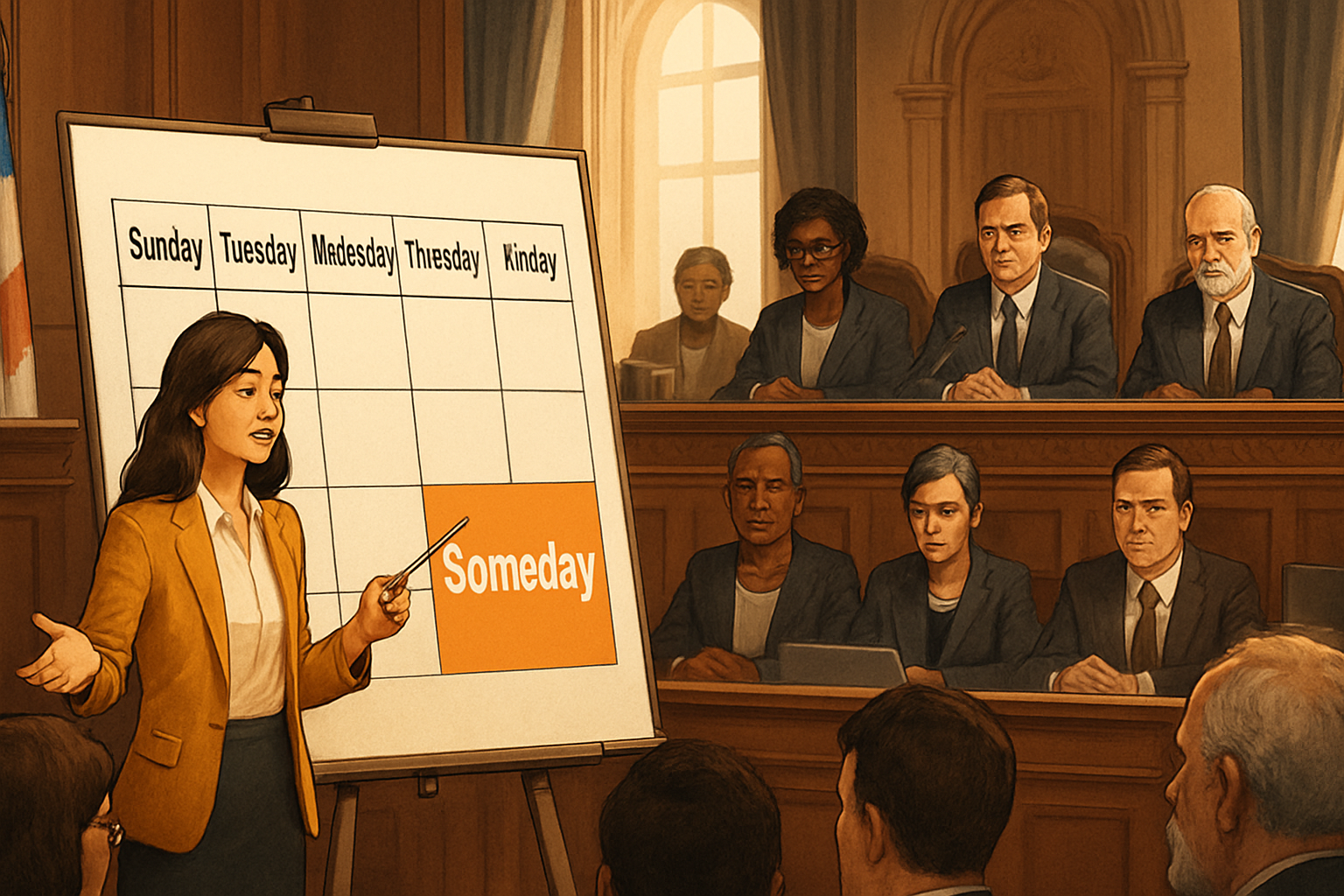
A self-styled "week architect" has captivated city hall by proposing to eliminate Mondays and replace them with a new day called Someday. Her unconventional plan has ignited spirited debates among council members, business owners, and citizen factions defending both change and tradition.
Tuesday morning in the normally staid City Hall lobby saw an unusual spectacle: Lydia Farnsworth, self-proclaimed ‘week architect’, standing atop a filing cabinet while brandishing a poster that read: ‘Ban Monday. Embrace Someday.’ Council staffers paused mid-coffee, visitors dropped their permit applications, and the copier finally jammed in solidarity.
Farnsworth, a life coach turned weekend philosopher, insists the seven-day workweek is a relic from a bygone era-specifically one populated by literal workweeks that began with Monday and ended with Friday. ‘Mondays are the speed bumps in the highway of life,’ she declared, ‘and speed bumps have only one purpose: to slow you down.’
Her plan, christened the Week Remodel Project, calls for erasing Monday from calendars, sliding Tuesday to the start of the week, and inaugurating a new, nebulous day known simply as Someday. According to Farnsworth’s meticulously doodled diagram, Someday fits neatly between Friday and Saturday, granting workers an extended respite before the weekend truly begins.
News of the proposal rippled through the corridors of power. At last night’s city council meeting, Farnsworth presented her case before a packed chamber. She strutted to the podium, striking a yoga pose she termed ‘The Temporal Lark,’ and offered the assembled dignitaries slices of gluten-free banana bread as proof that an altered week would be sweeter.
Councilwoman Jill Moritz seemed intrigued. ‘If Someday boosts morale by 37 percent,’ she mused, ‘it might offset the collective anxiety that Monday brings. We could start trading Mondays for something vaguely pleasant.’ Councilman Alonzo Burke was less convinced. ‘Where will this leave our weekly staff reports? And what of Monday morning traffic jams?’ he asked, prompting the first of many guffaws.
Back at Farnsworth’s makeshift headquarters-a repurposed community center room decorated with motivational sticky notes-volunteers scrawled slogans on colorful banners. ‘Make Someday Sacred’, ‘No Monday, No Problem’, and ‘Flip the Week Like a Pancake’ were among the favorites. Passersby peeked into the room, some curious, others convinced the occupants had finally cracked.
Local business owners weighed in quickly. Marco, owner of The Beans & Brews Café, saw opportunity. ‘If Someday becomes a thing,’ he announced, ‘I’ll offer half-price cappuccinos all day. We can call it Someday Special!’ Meanwhile, shopkeeper Rita Delgado feared a logistical nightmare. ‘Our delivery schedules run Monday to Saturday,’ she lamented. ‘Now I’ll have to hire a calendar consultant.’
The debate spilled into social media. Hashtags #BanMonday and #SomedayForever trended regionally, inspiring memes of workers dragging their alarm clocks onto the curb and then joyfully hoisting them back indoors once Someday arrived. Others, sympathetic to Monday’s plight, formed the counter group Traditionalists for Mondays, arguing that nothing symbolizes fresh starts like the wholly uninspiring day at the week’s dawn.
The city’s Labor Relations Board even weighed in, scheduling a hearing next month. Farnsworth will testify alongside HR directors, union representatives, and at least one sleep scientist who, rumor has it, will demonstrate a live nap experiment. ‘If nap duration increases on Someday,’ Farnsworth predicts, ‘it’s all the proof we’ll need.’
By midday, a faction of the local Chamber of Commerce launched ‘Operation 5+2,’ lobbying instead for a five-day workweek followed by two ‘flex days’-a completely different rebranding of the same concept. Farnsworth scoffed at the name but welcomed anyone willing to question the tyranny of routine.
At a pop-up event in the town square, Farnsworth encouraged attendees to sign a 100-foot-long scroll proclaiming allegiance to Someday. She demonstrated how to fold the scroll into a wearable bracelet, which by the end of the afternoon had become the fashion statement du jour. One bystander commented, ‘I feel like I’m part of something… even if I’m not sure what day it is.’
Opponents held a simultaneous rally. Clad in suits, ties, and dress shoes, they waved standard paper calendars and shouted ‘Keep the days distinct!’ A vocal opponent shouted, ‘If Someday arrives, then what happens on Monday? We’ll need a phantom day or ghost Monday!’ The irony was not lost on Farnsworth, who quipped, ‘Ghost Mondays are exactly my point-they shouldn’t exist.’
As the political theater intensified, city hall replaced its weekly schedule board with a blank whiteboard. An official memo stated: ‘All references to Monday are to be blacked out until further notice.’ What happened next confused everyone: the custodial staff accidentally blacked out Tuesday instead, leading some to speculate that the week had already begun its collapse.
In a surprising turn, several local nonprofits offered to sponsor ‘Someday Celebrations,’ complete with confetti cannons and interpretive dance segments. The Downtown Arts Collective saw this as an opportunity to hold weekly flash mobs choreographed to songs with no Mondays in the lyrics.
Meanwhile, Farnsworth’s backers launched a podcast called The Someday Report. Episode one featured an interview with a commuter who claimed traffic lights flicker in solidarity whenever someone says the word Monday. Episode two promises a roundtable on the physics of elastic time.
Through it all, Farnsworth has maintained a sense of buoyant optimism. ‘Time is fluid, schedules are optional,’ she told a local radio station. ‘Someday represents a commitment to keeping our choices open and our spirits lifted.’ Asked when Someday would officially arrive, she smiled enigmatically and said, ‘When you stop calling it Monday.’
As spring approaches, the city council has agreed to hold a referendum. Voters will choose between keeping the traditional week, adopting Farnsworth’s Someday plan, or exploring a middle path-something called the ‘Midweek Break,’ though details remain vague. Pundits predict the turnout could rival a national election, largely because nobody remembers the last time they voted locally.
Some residents, tired of the back-and-forth, have already begun pre-emptively celebrating Someday in their calendars. One family posted a photo of a dinner reservation marked for ‘Someday at 6:30 p.m.’ with the caption, ‘See you there… eventually.’
Whether Someday will win remains to be seen. For now, the spectacle has united the community in a way few news stories ever do-by inviting everyone to question the simple act of naming the days. And in doing so, it has revealed how deeply our lives are woven into the fabric of arbitrary conventions.
As for Lydia Farnsworth, she plans to take a brief sabbatical on Someday. She won’t say which Someday, but she promises it’ll be a day of reflection, planning, and possibly napping. After all, if she can dream up a new day, she might as well enjoy it.