Location
Mount Vernon, WA 98274
Location
Mount Vernon, WA 98274


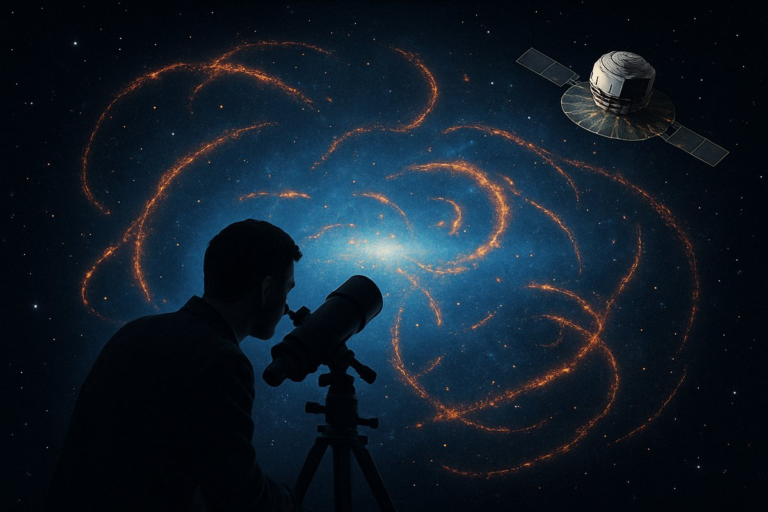
As a new generation of space-time mapping satellites and atomic-clock constellations prepare to transform navigation and scientific discovery, concerns are mounting over their capacity to double as powerful surveillance systems. This article explores the technical advances enabling unprecedented precision in cosmic cartography and examines the legal, ethical, and regulatory frameworks needed to safeguard individual privacy on Earth.
The last decade has seen an explosion in the number of satellites orbiting Earth-commercial imaging fleets, experimental quantum communications platforms, and soon, constellations of ultrastable atomic clocks designed to support future lunar and Mars missions. Originally conceived to refine deep-space navigation and unlock new insights into gravitational phenomena, many of these systems also have the potential to capture extraordinarily detailed data about terrestrial activities. As the boundary between scientific instrumentation and surveillance blurs, policymakers, engineers, and privacy advocates are racing to craft rules and technologies that both enable cosmic exploration and protect individual rights.
At the heart of this convergence lies the emerging architecture of distributed space-time networks. Scientists are deploying clusters of spacecraft equipped with chip-scale atomic clocks to create a self-synchronizing timing grid that spans Earth orbit and beyond. Early tests demonstrate timing precision on the order of femtoseconds-an achievement that promises centimeter-level positioning accuracy for spacecraft navigating the complex gravitational fields of the Earth-Moon system. On Earth’s surface, these same networks could refine global navigation satellite systems (GNSS) to an unprecedented degree, enabling everything from autonomous vehicles to precision agriculture with minimal latency. Yet the very mechanisms that tighten the link between space and time can also be repurposed to monitor ground-based movements, map shipping lanes, or track urban traffic patterns with far greater granularity than existing radar or lidar platforms.
Meanwhile, advances in multispectral and synthetic-aperture imaging are delivering sharper, faster snapshots of our planet. New commercial imaging satellites employ onboard AI to preprocess and tag features-vehicles, infrastructure changes, environmental shifts-before relaying only distilled metadata to ground stations. Proponents argue this approach reduces data transmission costs and accelerates actionable insights, from disaster response to habitat monitoring. But critics warn that it creates a parallel network of automated surveillance that skirts traditional oversight. When imagery feeds into terrestrial databases governed by varying levels of data protection, there is a genuine risk of function creep: sensors deployed to monitor coastal erosion could be repurposed to track crowds at public events, or to identify faces in parking lots.
A key technical enabler of these capabilities is the marriage of quantum communication protocols with orbital platforms. Pioneering experiments in satellite-based quantum key distribution have proven that entangled photon pairs can be shared over thousands of kilometers, establishing cryptographically secure channels immune to eavesdropping. In theory, this technology could be embedded in next-generation Earth observation satellites to guarantee the integrity of data links and assure sensitive industrial or governmental clients that imagery cannot be tampered with in transit. At the same time, quantum sensors designed to detect minute variations in gravitational fields-conceptual descendants of terrestrial gravimeters-could someday map subsurface structures and even detect underground movements. Such sensors raise novel privacy questions: might mineral exploration outfits deploy ultra-sensitive gravimetry to peer beneath private land without consent?
These technical breakthroughs are unfolding against a backdrop of evolving space governance. The Outer Space Treaty of 1967 established the principle that celestial bodies are to be used for peaceful purposes, but it predates today’s high-resolution imaging and quantum networks. In recent United Nations sessions, delegations have sparred over draft guidelines for transparency in earth observation, calling for voluntary notification regimes and data-sharing agreements. Meanwhile, an international coalition led by digital rights groups is advocating for a “Digital Geneva Convention” for space-binding rules that would prohibit intrusive surveillance acts using space-borne assets. Industry associations have countered that overly restrictive measures might stifle innovation in areas such as disaster monitoring and climate research.
On the regulatory front, individual nations are racing to keep pace. Some have proposed licensing regimes that require satellite operators to submit detailed mission plans, including data-handling policies and de-identification procedures. Others are exploring technical mandates: data anonymization protocols, time-limited storage windows, or differential privacy algorithms that introduce statistical noise to prevent reidentification of individuals. Yet many of these proposals face steep challenges at the implementation stage. Once raw imagery or sensor logs enter a global data marketplace, they may be aggregated with third-party commercial datasets-social media posts, location histories, or purchase records-creating combined profiles that elude existing privacy safeguards.
Beyond formal regulation, a growing number of engineers and designers are embracing a values-driven approach to system architecture. Privacy by design, a concept popularized in the software realm, is being adapted for aerospace. Teams are experimenting with onboard data filters that automatically redact anything below a certain geographic scale-obliterating pixel-level detail for land areas under legal dispute, for instance-while preserving broader environmental or scientific readings. Others are exploring secure enclaves within satellite hardware, akin to trusted execution environments, that isolate sensitive processing tasks from the satellite’s general computing fabric. If widely adopted, these patterns could curb certain surveillance vectors before data ever leaves the spacecraft.
Of course, technology is only part of the solution. Public awareness and civil society engagement will be essential to ensure that the benefits of space-time networks are shared equitably, without compromising fundamental rights. Educational initiatives are under way to help communities interpret satellite data and understand the balance between transparency and privacy. Nonprofit organizations are training citizen scientists in the use of open-source orbital data, empowering them to monitor environmental changes while also spotting potential abuses in local land management or security operations.
The tension between cosmic exploration and terrestrial oversight will only intensify as human activity extends deeper into the solar system. Proposed outposts on the Moon and Mars will rely on their own navigation and communication networks-satellites, relay stations, and timing beacons-to operate safely across vast distances. Lessons learned today about data sovereignty and privacy will shape not just Earth’s digital infrastructure but the social norms of future off-world communities. Will lunar settlers enjoy the same protections against unwarranted surveillance as citizens on Earth, or will the logistical and political complexities of interplanetary governance undermine those safeguards?
Balancing these competing demands requires a holistic perspective. Scientists and engineers must factor in privacy impacts from the earliest design phases, while policymakers and rights advocates should maintain an in-orbit view of how data flows between governments, corporations, and individuals. International cooperation models-such as those that govern the International Space Station-could serve as templates for data-sharing protocols that lock in privacy guarantees in perpetuity. Meanwhile, novel legal tools like smart contracts on blockchain platforms could enable dynamic consent agreements, so individuals or communities can stipulate exactly how their local imagery or sensor data may be used, and revoke permissions if those terms are violated.
The same technologies that bring the farthest reaches of the cosmos into focus can also shine a light on our everyday lives. Navigating that paradox safely means acknowledging that space-time networks are not neutral instruments. They are powerful tools shaped by design choices, legal frameworks, and societal values. As we map the next frontier-from the orbits above to the planets beyond-our challenge will be to ensure that the quest for knowledge does not come at the expense of the privacy and dignity of those we aim to serve. In that balance lies the future of both cosmic discovery and individual freedom.