Location
Mount Vernon, WA 98274
Location
Mount Vernon, WA 98274

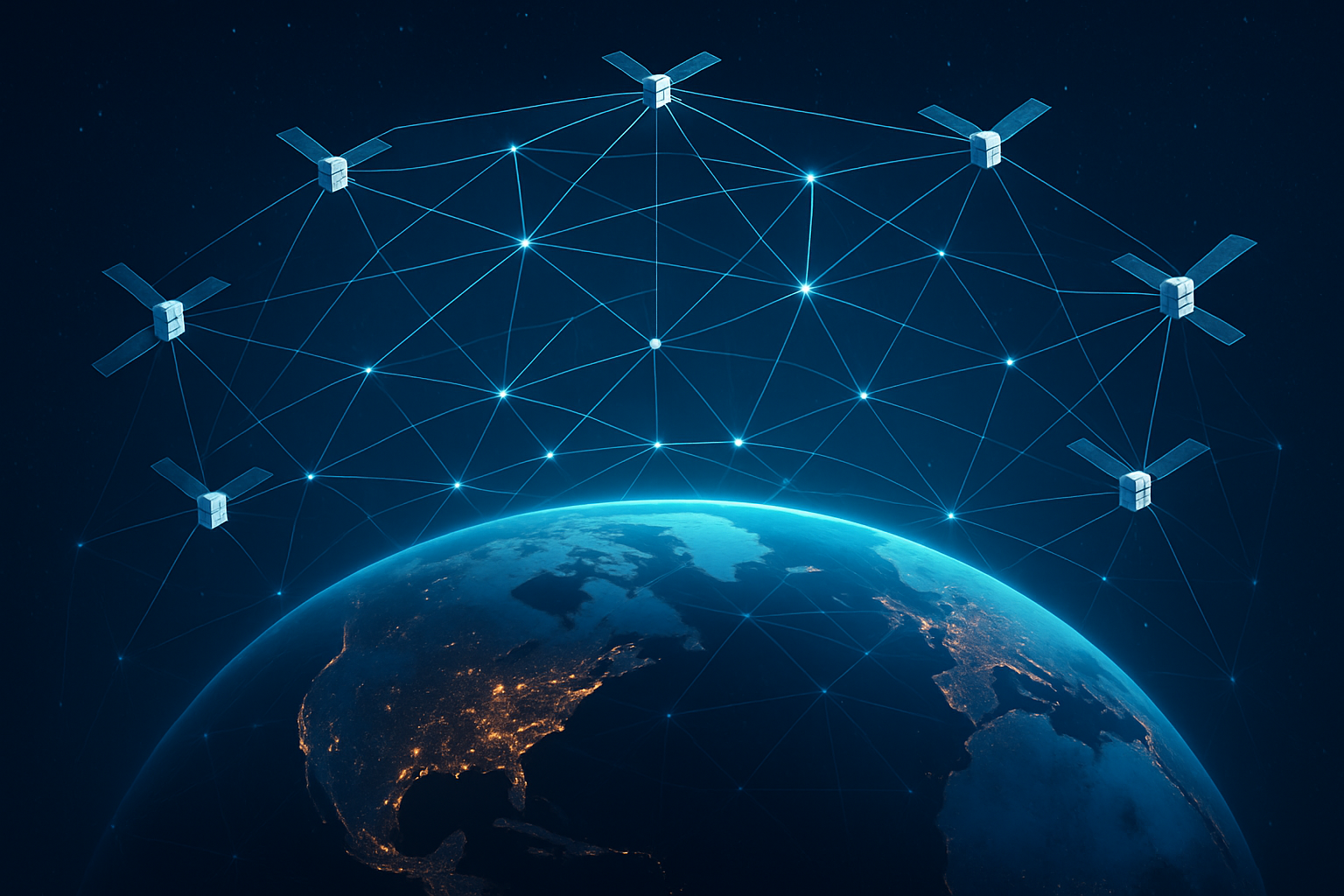
New low-Earth orbit mesh networks promise near-instant connectivity and real-time sensor fusion across continents, but they also raise formidable questions about metadata collection, hidden surveillance vectors, and the ethical boundaries of space-based data gathering. As regulators and technologists race to establish norms, satellite operators and end users must weigh the rewards of universal coverage against the risks to individual privacy.
At dawn last month, a research team stationed on a remote mountain ridge witnessed a flurry of small satellites coordinating a time-domain experiment that streamed high-resolution environmental data in real time. From atmospheric readings and wildlife tracking to ultralow latency video links, this constellation demonstrated an unprecedented capacity to blur the line between terrestrial networks and celestial infrastructure. But alongside the excitement over ubiquitous connectivity came murmurs of unease: Who ultimately controls this torrent of data in orbit, and what privacy safeguards exist once the satellites begin advertising commercial service?
Built from dozens of modular nodes in low-Earth orbit, these emerging mesh networks leverage crosslink lasers, intersatellite radio relays, and advanced time synchronization techniques to achieve sub-millisecond latency on a planetary scale. Unlike traditional geostationary platforms lofted tens of thousands of kilometers above the equator, these constellations operate at altitudes ranging from 400 to 1,200 kilometers, minimizing signal delay and opening the door to real-time Internet of Things telemetry anywhere on Earth. The networks promise to extend broadband to underserved regions, enable resilient emergency communications, and accelerate scientific collaborations that span continents.
Central to this transformation is a precise choreography of clocks dispersed through space. Research teams are developing quantum-enhanced timekeeping modules that compensate for relativistic effects, ensuring each satellite remains locked to a universal reference. By embedding superaccurate atomic clocks within laser-phased arrays, network designers can compensate for the time dilation caused by both orbital speed and subtle gravitational gradients. The result is a fabric of space-time communication that can deliver live data streams, remote surgery links, or distributed sensor readings with a coherence level previously confined to laboratory testbeds.
As these meshes gain momentum, they carry onboard sensor suites capable of gathering geolocation, temperature, motion, and spectral information across vast regions simultaneously. Environmental watchdogs anticipate using them to monitor deforestation fronts and track glacier melt in near real time. Maritime authorities foresee automatic identification broadcasts for every vessel crossing sensitive sea lanes. Humanitarian agencies plan to integrate portable ground stations that can mesh with satellites during disaster relief missions, enabling field medics to consult specialists halfway around the world instantly.
Yet the same abilities that empower open science and global outreach also fuel concerns over metadata capture and overt surveillance. By triangulating signals of nearby radio emitters or logging broadcast footprints, the networks could reconstruct movement patterns of vehicles, vessels, or personal devices. Even encrypted communications leave behind traffic signatures. With sophisticated analysis, edge nodes in orbit might infer attendance at gatherings, identify patrol routes, or uncover supply chain flows-all without requiring ground-based monitoring stations.
To mitigate such risks, engineers are embedding onboard compute clusters that apply privacy-preserving algorithms before data ever reaches terrestrial servers. Differential privacy techniques add controlled noise to aggregated readings, preventing the reconstruction of individual trajectories while preserving statistical value for environmental analysis. Homomorphic encryption experiments are underway to allow mathematical operations on ciphertext, meaning satellites can perform filtering or classification tasks without exposing raw data to human operators. In principle, these safeguards ensure that sensitive patterns remain concealed even if a node is compromised.
Nevertheless, the prospect of state actors or well-funded private entities exploiting these networks as surveillance platforms has spurred a global policy debate. Military planners recognize the strategic value of real-time spaceborne intelligence, while civil liberties groups warn that the absence of transparent oversight could usher in a new era of orbital eavesdropping. In regions with limited press freedom, satellite networks could be commandeered to track political dissidents or censor emerging communications channels.
Commercial providers, eager to maintain customer trust, have published draft data protection charters that promise to restrict third-party access, mandate end-to-end encryption, and log all interception requests in public registries. Industry consortia are evaluating blockchain-inspired audit trails to certify every data handoff, ensuring end users can verify whether their streams have been processed by authorized systems only. Some operators pledge to open their flight software for external review, inviting privacy researchers to identify potential backdoors or overly broad data retention policies.
Regulatory bodies are scrambling to catch up. International telecommunication unions are debating amendments to orbital data governance treaties, while regional commissions consider extending terrestrial data protection rules into spaceborne territory. Proposals include mandatory Data Protection Impact Assessments for any satellite launch above a certain altitude, compulsory reporting of metadata collection practices, and time-limited licenses that require periodic audits. A coalition of national delegates has floated the idea of a Space Privacy Pact, akin to maritime law, that binds signatories to common transparency and consent standards for satellite-based data gathering.
On the technology front, new encryption chips designed for the harsh conditions of space are entering qualification trials. Radiation-hardened secure elements can store cryptographic keys in tamper-resistant enclaves, preventing unauthorized access even if the satellite falls into adversarial hands. Advanced secure boot mechanisms ensure that only vetted firmware can run on communication modules, mitigating the risk of remote code injection or firmware hijacking. Research labs are also testing proximity-based key exchange protocols that allow ground devices to authenticate themselves just before uplink, preventing ghost stations or spoofed terminals from piggybacking on legitimate networks.
Community advocates, indigenous groups, and academic coalitions are forming alliances to shape governance frameworks from the outset. Workshops in remote regions teach local stakeholders how to audit data streams, verify network claims, and demand contractual privacy guarantees from service providers. Open-source toolkits provide citizens with the means to run basic satellite telemetry decoders on low-cost hardware, illuminating exactly which frequencies and cropping patterns operators are using in their latitudes.
Sustainability and space debris mitigation remain entwined with the privacy debate. Operators are trialing deployable drag sails and electrodynamic tethers that deorbit defunct nodes within months of mission end, reducing collision risks and limiting the lifespan of potential surveillance assets. By designing constellations with shorter service windows, advocates argue it becomes easier to enforce periodic license renewals, during which privacy compliance can be re-examined.
As humanity pushes the boundaries of connectivity into the heavens, the tension between universal access and individual privacy intensifies. The rules we establish today will shape the ethics of tomorrow’s cosmic grid, determining whether satellites become guardians of global wellbeing or instruments of unseen oversight. By combining rigorous policy, open technology, and vigilant public engagement, stakeholders can chart a course that honors both the promise of boundless communication and the right to private life under every sky.
In the vast expanse above, every orbiting node carries a choice: to illuminate knowledge or to cast unseen shadows. Our collective task is to ensure that this emerging tapestry of space-time networks reflects our highest values, preserving the right to explore, connect, and innovate without sacrificing the sanctuary of personal privacy.