Location
Mount Vernon, WA 98274
Location
Mount Vernon, WA 98274

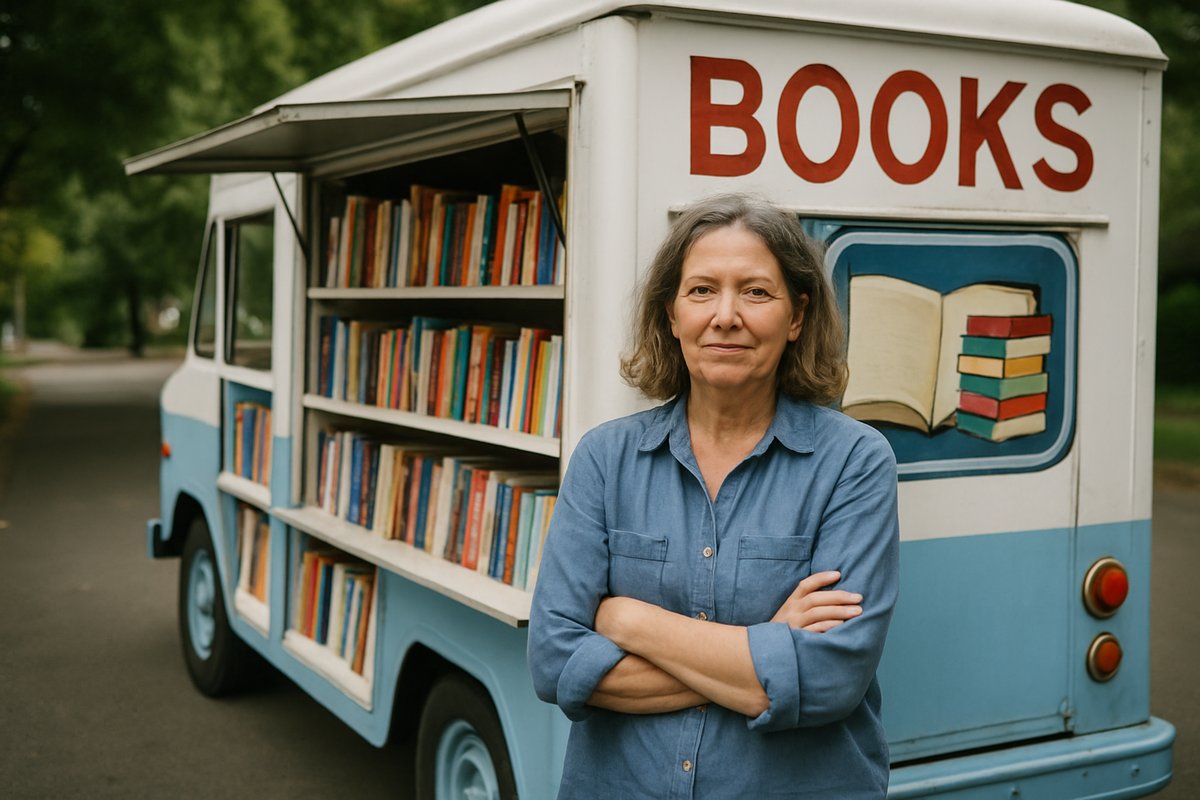
A former factory worker in Maplewood transformed a retired ice cream truck into a mobile book cart, bringing free literature to underserved neighborhoods. Her journey from despair to community champion highlights the quiet courage found in human resilience and the power of small acts of hope.
On a misty Monday morning in Maplewood, the familiar hum of engines was replaced by the gentle clatter of books being shelved. A pastel-blue truck rolled down the streets, its sides lined with hand-painted murals of storybook characters and open pages. Residents gathered at the corner of Fifth Avenue and Pine Street, curious faces pressed against the glass as a volunteer unlocked the rear doors and revealed shelf after shelf of paperbacks, hardcovers and children’s tales. This transformation of an old ice cream truck into a mobile book cart has become an emblem of renewal for a town still grappling with economic shifts and fading communal spaces.
Sara Nguyen, the creator of this roaming library, was once a machinist at the very factory whose closure sent shockwaves through Maplewood three years ago. After clocking in daily for six years, she found her role eliminated as the plant moved operations overseas. The abrupt job loss triggered a period of isolation and uncertainty. “I spent weeks scrolling through job boards, but no position felt like mine,” she recalls. “It wasn’t just a paycheck I lost. It was my purpose, my daily rhythm, my connection to others.” Amid sleepless nights and mounting bills, Sara turned to the local public library, seeking solace in the quiet aisles.
It wasn’t long before Sara volunteered for storytelling hours and literacy outreach, discovering that sharing books ignited the same spark she missed in her factory role. Witnessing a child’s eyes widen during a fairy-tale reading or an adult nod appreciatively at a local history volume reminded her that human connection often blooms through shared stories. Encouraged by librarians and neighbors, she sketched a plan to fuse her mechanical know-how with her renewed passion for community service.
By the following spring, she had sourced a decommissioned ice cream truck chassis from a neighbor’s farm. With help from two retired mechanics, Sara refitted the vehicle: dismantling the old freezer units, installing adjustable shelves, and adding weatherproof curtains to protect books during sudden showers. Artists from the local community center volunteered their time to paint vibrant illustrations along the truck’s exterior. The result was more than a mobile library-it was a rolling canvas that announced from blocks away, “Books and hope are arriving soon.”
To stock the shelves, Sara organized donation drives in coffee shops, community centers and schools. Within weeks, she collected more than 5,000 gently used books, spanning picture books, adult fiction, graphic novels and self-help titles. Each volume was cataloged, tagged with a friendly note about its previous reader, then placed in a cubby labeled “Take one, leave one if you can.” The system proved so effective that within days, readers were swapping titles, sharing recommendations and leaving behind works inspired by their own lives.
The inaugural route launched on a brisk autumn afternoon along the East Elm corridor, a neighborhood long marked by limited public resources. Families bundled in scarves formed a line as Sara greeted each person with a warm smile and a nod. At the local park, she set up a portable reading nook-blankets spread on the grass, a small table for coloring books and a blackboard listing featured titles of the week. Children dove into stories of dragons and space explorers, while adults lingered over memoirs and poetry collections.
Among the visitors was Javier, a high school sophomore who struggled with remote learning earlier in the year. He confessed that he hadn’t enjoyed reading since elementary school, but after borrowing a science-fiction novel from the cart, he found himself waking up early to read chapters before breakfast. “It’s like discovering a new world right outside my window,” he said, handing the book back for the next person. Nearby, Marisol, a retired veteran, flipped through a collection of memoirs that mirrored her own experiences overseas. She paused to jot notes in a journal she’d purchased at a dollar store and promised to bring back her typed reflections for others to read.
Volunteers have become the lifeblood of the project, rotating shifts to drive the truck and staff pop-up reading sessions. Among them is Tony, a college sophomore studying education, who uses the cart hours as fieldwork for his degree. “Seeing the impact firsthand reminds me why I chose this path,” he explained. “Education isn’t confined to classrooms. It happens on street corners, in parks, wherever people gather and share.” Another volunteer, Amina, a newer arrival to Maplewood from overseas, found that helping out eased her own feelings of displacement. “When I help a child pick a book they love,” she said, “I feel at home.”
Challenges persist. The truck requires regular maintenance, from oil changes to new tires, and each storm poses a risk to the paperbacks. Sara has started hosting small fundraisers-everything from bake sales to poetry slams-to cover operating costs. Volunteer fatigue also looms; coordinating schedules among a rotating cast can be complex. Yet Sara remains undeterred. “Every obstacle reminds me why this matters,” she said. “When funding falls short, I remember the look on a student’s face when they hold a book for the first time.”
Beyond Maplewood, the mobile book cart has drawn attention from neighboring towns seeking to replicate its model. Sara has fielded calls from community organizers asking for schematics and tips for securing donated vehicles. She’s compiled a guide-covering everything from safety inspections to shelving design-and shared it freely online. “If this project can inspire another town to bring books to those who need them, that’s the greatest reward,” she reflected.
In an age when digital platforms often dominate our interactions, the sight of a humble truck laden with books reminds us of a simpler delight: the tactile joy of opening a page, the shared moment of discovery between reader and storyteller, and the unspoken bond of community. Maplewood’s mobile book cart is more than a repository of novels; it is a testament to quiet courage, communal resilience and the belief that even small acts can turn the page to a brighter chapter for us all.