Location
Mount Vernon, WA 98274
Location
Mount Vernon, WA 98274

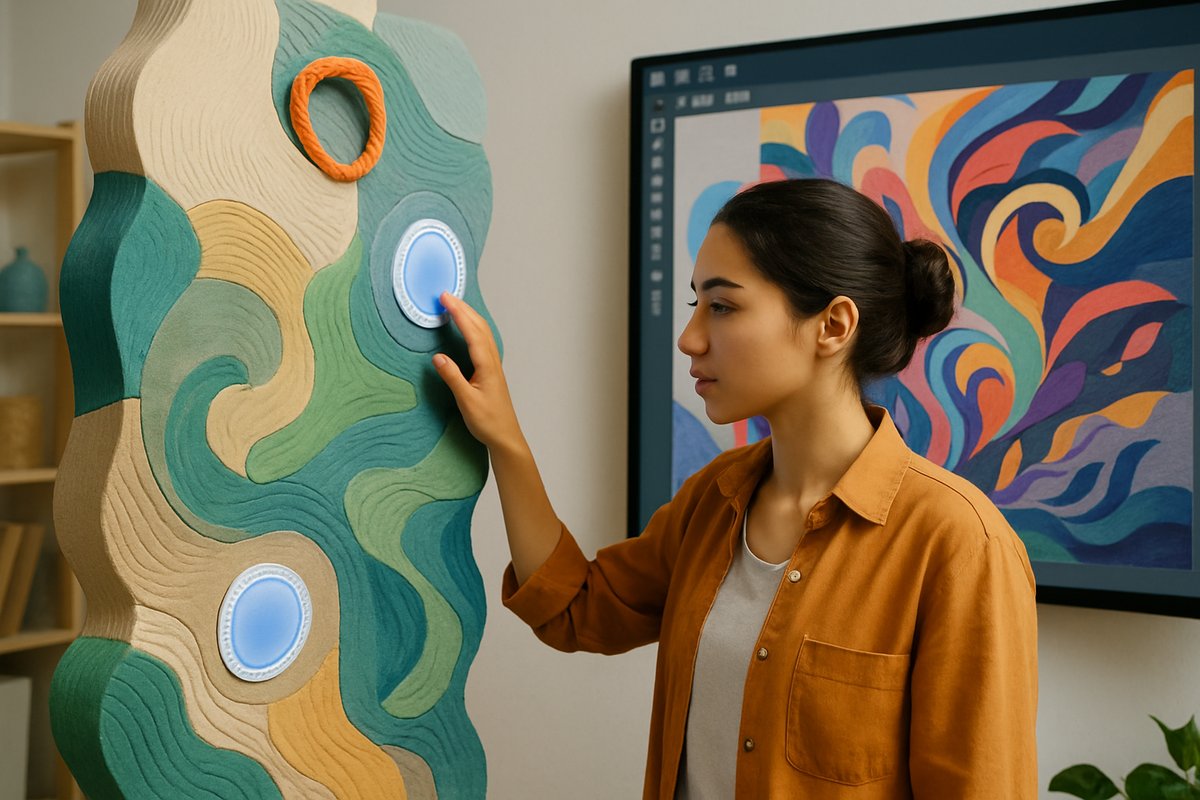
A new wave of creators is bridging the gap between tactile materials and digital innovation, forging immersive experiences that reshape how we view art and design. From sensor-embedded sculptures to AI-assisted murals, this movement champions sustainability, collaboration, and the playful spirit of experimentation.
In a converted warehouse on the outskirts of Berlin, a series of white cubes stands beneath soft glowing lights. Each cube houses a hybrid artwork-clay vessels inscribed with motion sensors, resin sculptures overlaid with projection-mapped animations, and textile panels embroidered with conductive threads. Visitors don wireless earbuds that guide them through soundscapes triggered by touch, transforming the gallery into a living organism that responds to curiosity. This exhibition is far from a one-off spectacle: it reflects a global shift toward hybrid art practices where analog craft meets digital code.
Over the past two years, a growing number of artists and designers have embraced tools once confined to engineering labs-3D printers, microcontrollers, augmented-reality toolkits-to augment traditional methods like painting, ceramics, and weaving. The result is a playful hybridity: delicate papier-mâché forms that light up in response to movement, murals that rearrange their color palettes according to real-time data feeds, and wood-carved reliefs that subtly vibrate to ambient sound. The movement is fueled by open-source communities sharing libraries of code, step-by-step fabrication guides, and troubleshooting tips on social platforms dedicated to maker culture.
Behind the scenes, sustainability has emerged as a priority. Artists are experimenting with recycled plastics sourced from ocean cleanup projects, biodegradable pigments made from botanical extracts, and low-energy display processes that rely on solar panels or hand-cranked dynamos. One team in Tokyo repurposes discarded electronic parts to produce kinetic sculptures, turning e-waste into a commentary on consumer culture while giving items a second life. Across three continents, studios have adopted closed-loop systems: water used to rinse clay is captured and filtered, leftover resin is cured into modular bricks, and digital prototypes are tested in virtual reality before any material is consumed.
Key to this evolution is the concept of co-creation. Unlike traditional exhibitions where art is presented as a finished product, hybrid practices often invite audience participation. Touch sensors embedded in ceramic bowls might alter projected imagery when a hand draws near. A digitally printed tapestry can shift its pattern based on whispered words captured by a hidden microphone. In one recent showcase, gallery-goers programmed simple commands to an on-site drawing robot, witnessing their own doodles brought to life in ink on paper. The boundary between artist and observer becomes permeable, encouraging a spirit of play and discovery.
Emerging from the intersection of maker spaces and art academies, hybrid practitioners blur roles. A sculptor might learn basic coding to automate a mechanized armature, while a software designer experiments with clay modeling as a way to refine spatial reasoning. Workshops in cities from São Paulo to Stockholm bustle with participants learning how to design circuit boards alongside calligraphy techniques. These cross-disciplinary labs highlight an essential insight: form and function need not exist in isolation. The embossed patterns of ceramics can become capacitive sensors; the weave of a tapestry can host conductive yarns that carry data signals. In these hands, materials speak a shared language of texture, light, and motion.
On the theoretical front, this movement is reshaping definitions of authorship and materiality. When a painting’s colors evolve based on Twitter sentiment or an algorithm remixes a sculpture’s digital twin, who claims creative credit? Hybrid artists often opt for transparent licensing, releasing original code under permissive terms so others can remix, adapt, and build upon their work. This ethos echoes an earlier era of design cooperatives, yet now extends into the realm of bits and bytes. Digital files, unlike physical objects, can be duplicated infinitely-but when tied to handcrafted elements, they gain a new aura of singularity.
Galleries and museums are taking notice. A museum in Minneapolis recently installed an interactive LED-infused floor that responds to footsteps, projecting patterns reminiscent of rippling water. Visitors become protagonists in a choreography of light, their own movements shaping the visual environment. Elsewhere, a museum in Dubai unveiled an immersive chamber where VR headsets blend with tactile walls lined in moiré-patterned fabric, creating a dreamlike space that oscillates between digital abstraction and tangible texture. Institutions are testing flexible models for display, accommodating artworks that demand continual software updates or environmental calibration.
Despite the excitement, hybrid art faces challenges. The learning curve for new digital tools can be steep; mastering circuit design, calibration, and code debugging often requires collaboration with technologists. The cost of high-resolution projectors, motion-capture cameras, and reliable energy storage can strain small studios. Moreover, the carbon footprint of cloud servers hosting interactive experiences invites scrutiny from sustainability advocates. In response, some collectives are exploring low-tech alternatives: pneumatic actuators over power-hungry motors, solar-charged microcontrollers, and local-area networks that bypass remote servers.
Workshops that pair art students with environmental scientists are emerging to address these issues. In Melbourne, a summer residency brought together ceramicists, sustainable-materials researchers, and open-hardware developers to prototype energy-neutral installations. Their flagship piece-a pavilion clad in bioplastic panels that filtered rainwater-demonstrated how hybrid design could be both poetic and pragmatic. By placing material research at the core of artistic exploration, these programs equip creatives to navigate ecological concerns without sacrificing expressive potential.
As hybrid art enters mainstream galleries, commercial designers are integrating similar strategies. Architecture firms propose interactive facades that adjust transparency based on sunlight intensity. Furniture makers embed LED arrays beneath wood surfaces, offering subtle ambient notification systems. Fashion designers weave conductive thread into garments that light up in response to muscle movement. The cross-pollination is explicit: just as digital natives seek tactile experiences to offset screen fatigue, traditional craftspeople embrace digital augmentation to remain competitive in a connected marketplace.
Looking ahead, the frontier continues to expand. Artists are experimenting with biohybrid systems-living microorganisms embedded in sculptural matrices that glow under certain stimuli. Neural-network-driven printers generate ceramic forms that evolve in shape according to environmental sensor readings. Collaborative cloud platforms allow remote contributors to tweak parameters in real time, creating artworks that exist simultaneously in physical galleries and digital metaverses.
This surge of hybrid imagination signals more than a passing trend; it points to a redefinition of what art and design can be. By embracing tools from coding to composting, practitioners forge a holistic approach where ideas are tested in both silicon and soil. The gallery becomes a lab, the studio a microcosm of global networks, and the audience an active participant in co-creation. In this new world, creativity is not bound by medium but liberated by curiosity.
Whether you’re drawn to sculptural experiments that pulse with light or woven installations that archive real-time data, the hybrid art movement offers an invitation: to explore, to question, and to reimagine the fabric of everyday experience. It reminds us that art is not a static object behind glass but a living dialogue between maker, material, and moment. And as canvas meets code, the possibilities feel as limitless as the human imagination itself.