Location
Mount Vernon, WA 98274
Location
Mount Vernon, WA 98274

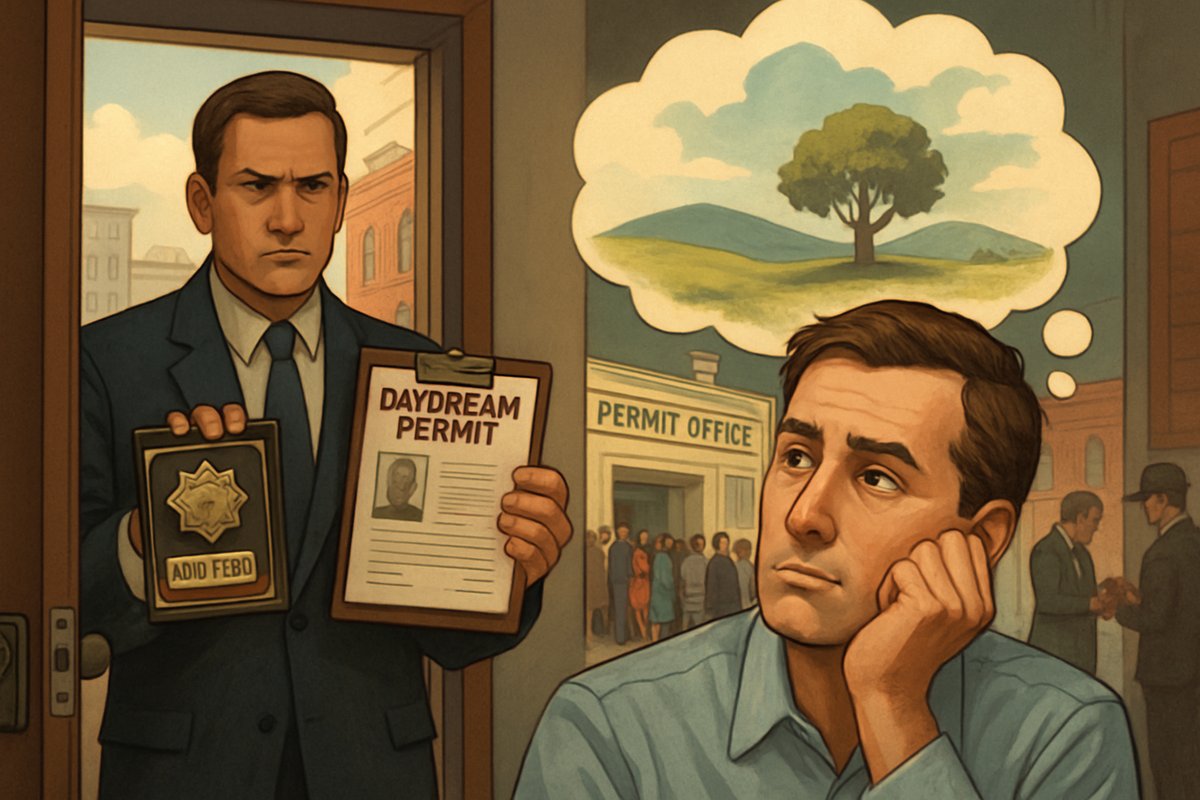
In an unprecedented move, the Peachtree Falls Council has classified daydreaming as a controlled substance, demanding residents obtain official permits before indulging in unauthorized mental wanderings. Citizens report lines at the permit office, black-market flashback traders, and surprise "dream audits" popping up around town.
On an otherwise unremarkable Wednesday morning, the Peachtree Falls Council convened in the newly refurbished Community Chamber to pass the Daydream Regulation Act, a sweeping ordinance labeling unlicensed daydreaming a Class B misdemeanor. Under the new law, any resident wishing to drift off into idle thoughts, fantasies, or mental scenarios must first submit a Daydreamer Permit application-complete with fingerprint scan and a notarized statement of intent-alongside a nonrefundable $50 processing fee. Council Chairperson Marjorie Kravitz insisted the measure was necessary to curb “psychic overcrowding,” arguing that unregulated mental meandering posed a threat to municipal order.
Within hours, the permit office outside City Hall had formed a queue stretching half a block, as bewildered citizens clutched yellow permit forms like lifelines. Local barista Tina Marshall sighed as she waited for her turn, clutching a laminated copy of last year’s holiday special recipe card. “I just want to think about frothy caramel drizzle for five minutes,” she muttered. “Now I have to fill out a 12-page questionnaire about my fantasy coffee consumption and answer whether I plan to daydream about whipped cream or just skim milk.” Neighbors whispered tales of senior citizens recently detained for “metaphorical time trips” to their youth and second-grade teachers cited for “illegal nostalgia.”
Inside the Permit Verification Department, newly hired civil servants in crisp uniforms directed residents through a labyrinth of cubicles. “We have to ensure every daydream meets safety protocols,” explained permit clerk Ramon Ortega, adjusting his wire-frame glasses. “No roving specters, no unauthorized plot twists, and absolutely no crossover with copyrighted movie scripts.” Each applicant undergoes a biweekly Dream Audit-an officer-supervised session in which the applicant closes their eyes while an adjudicator takes notes on the veracity of any mental imagery produced. Failure to produce a coherent daydream results in a 30-day suspension of the permit and mandatory attendance at Focus Workshops designed to “retrain wayward imaginations.”
Almost immediately, a subterranean daydream black market emerged. A group calling itself the Reverie Ring began hawking “Flashback Vouchers”-hand-drawn index cards purported to unlock unauthorized memories or creative sequences. Vendors set up clandestine booths at late-night jam sessions, offering pre-approved nostalgia experiences for a modest fee. One such vendor, who identified himself only as “Somni,” explained, “I can get you a seven-minute seaside reverie or a 20-second high-school prom retake. All you need is a signed waiver and an envelope full of loose change.” Market rates reportedly peaked at $200 for deluxe dream scenarios featuring celebrity impersonations and choreographed ballroom sequences.
To enforce the new statutes, Peachtree Falls deployed its newly minted Dream Patrol-uniformed officers armed with Yaffle-brand dream-detection wands and portable MindTune scanners. These devices claim to detect unauthorized neural oscillations indicative of unauthorized fantasizing. Late last week, Patrol Officer Lucy Han intercepted a group of teenagers reportedly drifting into daydreamed dance battles near the public library. “Their brains lit up like fireworks,” Han recounted. “We had to issue on-the-spot citations and confiscate all doodle notebooks.” Critics accuse the Patrol of heavy-handed tactics; one resident claimed she was cited while gazing at a mural of rolling hills and inadvertently envisioned a picnic.
The crackdown has escalated beyond mere bureaucratic snafus. Local high school teachers now adjust lesson plans to incorporate at least two psychometrically approved “focus intervals” per class to ensure students aren’t detained for dreaming of rock concerts or epic sci-fi battles. Drivers approaching crosswalks are reminded to refrain from daydreaming about seaside vacations until they have safely crossed the intersection. City buses now broadcast a stern recording: “All passengers must maintain active cognitive engagement. Unauthorized daydreaming could result in immediate ejection from the vehicle.” Even the annual county fair has rebranded its Dreamland funhouse as an “Officially Permitted Reverie Zone,” complete with on-site issued dream permits and signage warning, “No spontaneous musings beyond here.”
Meanwhile, the council’s coffers have swelled thanks to permit fees and fines, enabling the fast-tracking of neglected infrastructure projects. New streetlights now shine outside every permit office, ensuring applicants aren’t tempted by shadows. Pavement repairs once stalled for years were suddenly completed in record time. Council Chairperson Kravitz praised the revenue windfall, asserting, “We’re funding playgrounds with daydream dollars.” Critics, however, charge that the initiative unfairly penalizes the creatively inclined and punishes innocent citizens for harmless moments of introspection.
Public sentiment remains divided. A small band of protestors calling themselves the Dreamers’ Coalition stages “Dream-Ins” at the town square, pillows in hand, chanting, “Let our brains breathe!” They demand an immediate repeal of the Daydream Regulation Act, arguing the council has overstepped its mandate. In contrast, neighborhood watch groups have formed a volunteer Dream-Patrol Auxiliary to assist officials in rooting out “lope-limbed reveries” before they disrupt civic life. One enthusiastic auxiliary member noted, “I napped once for only three minutes and thought I might have designed a better city layout. That’s dangerous territory.”
In an ironic twist, a recent hearing to address widespread backlash was itself interrupted when Council Chairperson Kravitz slipped into an unscheduled daydream about her childhood treehouse and spent ten minutes describing the exact shade of bark in vivid detail. Observers recorded her murmurings-“It was like brown but gender-neutral, with undertones of optimism”-and termed it a “major breach.” Some residents now call for her resignation on the grounds that the law she championed should bind its own author. At press time, she remained defiantly at her desk, doodling mental images of proposed new regulations, and awaiting her own Dream Audit.
As city officials prepare to debate the next phase of regulations-rumored to include restrictions on doodling, humming, and eyebrow-raising-the citizens of Peachtree Falls brace for what one resident aptly described as a “bureaucratic trip through the looking glass.” Whether this grand social experiment will expand to include annual Thought Transference Certificates or become an object lesson in the perils of excessive governance remains to be seen. For now, at least, the town has successfully transformed its collective imagination into a taxable, ticketable, and thoroughly monitored commodity, proving that in Peachtree Falls, even your daydreams aren’t safe from red tape.