Location
Mount Vernon, WA 98274
Location
Mount Vernon, WA 98274


In a move blurring the line between bureaucracy and the supernatural, Harrowsville's City Council has passed an ordinance requiring every resident to submit a detailed account of any personal hauntings or spectral encounters. Failure to register a phantom could result in steep fines or compulsory attendance at remedial séances.
In a unanimous 7-0 vote last Tuesday, the Harrowsville City Council decreed that, effective immediately, all residents must complete the newly established Annual Personal Ghost Registry. The ordinance, championed by Councilmember Harriet Clawson, seeks to catalog every poltergeist, phantom, and wayward apparition haunting private homes, rental units, and office cubicles. Citizens have been instructed to file a 12-page form-available online and at City Hall-detailing the name (if known), approximate age, last known address, and dessert preference of each ghostly visitor. Failure to comply by the October 31 deadline will trigger fines escalating from five to fifty spectral credits-a currency that, surprisingly, only ghosts can spend.
Mayor Franklin Griggs praised the ordinance as a landmark in civic innovation. “For too long, our community suffered phantom-induced property damage without a central database,” he declared at a press briefing. “By collecting reliable information on poltergeists, we can deploy targeted ghost-management strategies and even reduce power surges caused by flickering lights.” The mayor’s presentation included a slideshow of recent complaints: smashed teacups, mysteriously rearranged sock drawers, and an inexplicable crescendo of Victorian waltz music emanating from the basement of 23 Maple Street.
Not everyone welcomed the new rules with open arms-or closed doors. Local resident and first-time haunted-house host Ingrid Moreno shook her head, clutching a stack of incomplete forms. “I love the idea of community oversight,” she admitted, “but I’ve lost count of how many times Harold the Herald appeared in my bedroom mirror. How do I know he’s not just Harold III? Does each sibling need its own registration?” Moreno’s dilemma underscores a central challenge: specters rarely carry identification, and zombie-like crowds have formed outside the clerk’s office, each holding floppy disks, scraps of paper, and even cassette tapes as proof of their ghostly interactions.
Behind the municipal building, a mobile pop-up stand labeled “Ghost Registrations-Walk-Ins Welcome!” advertises expedited service. The operator, self-styled medium Madame Zelena, wields a feathered fan and a stack of ornate ledger books. “I liaise between the living and the dearly departed,” she explains, signing forms with an ethereal quill pen. “I once registered a 19th-century chimney sweep whose favorite snack was pickles. The Registry rejected him for inadequate parchment quality-ridiculous!” Zelena’s stand boasts an express line for poltergeists over 150 years old, ensuring those with historical value earn priority treatment.
Meanwhile, the Harrowsville Spectral Compliance Office (HSCO) has scrambled to handle the influx of ghost data. Director Arnold Bright lamented that the new online portal crashed twice under the weight of 1,200 simultaneous uploads-half of them alleged sightings of Dennis the Deceiver, a mischievous spirit rumored to swap sugar for sand. “We never imagined a spirit economy could generate so much traffic,” Bright sighed, tapping at a keyboard speckled with ectoplasm. “Now we’re sorting through dozens of ambiguous entries like ‘shadow in the pantry’ or ‘laughter echoing through the walls.’ Those aren’t registrable entities-they’re just neighborhood teenagers.”
Not to be outdone, a coalition of local ghost-rights activists has formed. Their slogan, “No Taxation Without Haunting,” adorns handmade placards carried by both the living and a handful of transparent onlookers. At an impromptu rally in front of the courthouse, activist leader Tamsin Oceanside declared, “Spirits deserve autonomy! They shouldn’t be reduced to bureaucratic footnotes in a dusty ledger.” An attendee, identifying himself as Cedric-or possibly his ancestor-held up an old-fashioned scythe and called for a “Haunt Amnesty.” Police officers, uneasy about potential broomstick protests, kept a respectful distance.
Across town, local businesses scrambled to capitalize on the craze. Quill & Cauldron Printing offers custom-engraved parchment packets for ghost submissions, complete with vellum sleeves and wax-seal kits in varying shades of eerie green. Nearby, Shelly’s Séance Supplies launched limited-edition “Registry Ready” candles scented with sandalwood and old library books. “You’re not truly ready to register a spirit until you’ve set the mood,” Shelly proclaimed, lighting a dozen candles simultaneously to dramatic effect.
Even the Harrowsville Fire Department has gotten involved, dispatching a newly commissioned Ghost Capture Unit equipped with infrared goggles and “ectoplasm-approved” nets. Fire Chief Maria Trent smiled wryly as she demonstrated a gleaming silver snare to reporters. “Our priority is public safety,” she said, tossing the net over an imaginary specter. “Unregistered ghosts might not file tax returns, but they can still frighten children and toss curfews out the window.” The unit’s first mission involved rounding up a trio of unregistered spirits spotted tap-dancing on a rooftop-later identified as costumed theater students rehearsing a haunted play.
In the heart of downtown, a small ghost named Clarence voiced frustration in a scratchy recording played at the annual Town Hall Meeting. “I never asked to be documented,” he lamented in an otherworldly tremor. “I just enjoy drifting through walls and eavesdropping on late-night pizza orders.” Councilmembers paused as colleagues whispered, debating whether to amend the ordinance to include an “opt-out” clause for benevolent phantoms. Meanwhile, signage went up on utility poles: “Ghost Registry Helpdesk – 2 Blocks North – Ectoplasm-Friendly Staff!”
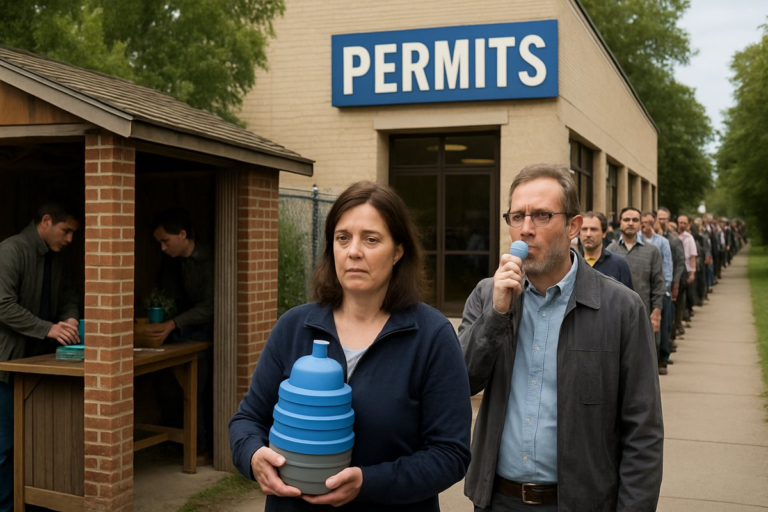
As the October 31 deadline approaches, long lines snake around municipal buildings and curiosity shoppers browse “spirit-proof” T-shirts at souvenir kiosks. A sense of carnival weirdness hangs in the air as seance-themed food trucks serve “Ecto Tacos” and “Spectral Smoothies.” Local radio stations run ghost registry jingles, complete with jingling bells and a chanting chorus. Even neighborhood children have joined the fun, swapping ghost registration cards like trading cards-some promising rare sightings of Civil War generals or Victorian governesses.
Whether this bureaucratic ritual will lead to fewer haunted closets and less fridge-shaking remains to be seen. One thing is certain: Harrowsville has transformed into a peculiar stage where the living and the dead share equal footing in municipal policy. As citizens scramble to complete their forms and candles flicker in windows, the community watches with bated breath-and perhaps the occasional spectral chill-wondering if this new ordinance will bind ghosts to civic responsibility or simply invite an even more spirited rebellion. In any case, the annual Ghost Form Day promises to be an unforgettable intersection of paperwork and the paranormal, blurring the line between governance and the great beyond.