Location
Mount Vernon, WA 98274
Location
Mount Vernon, WA 98274

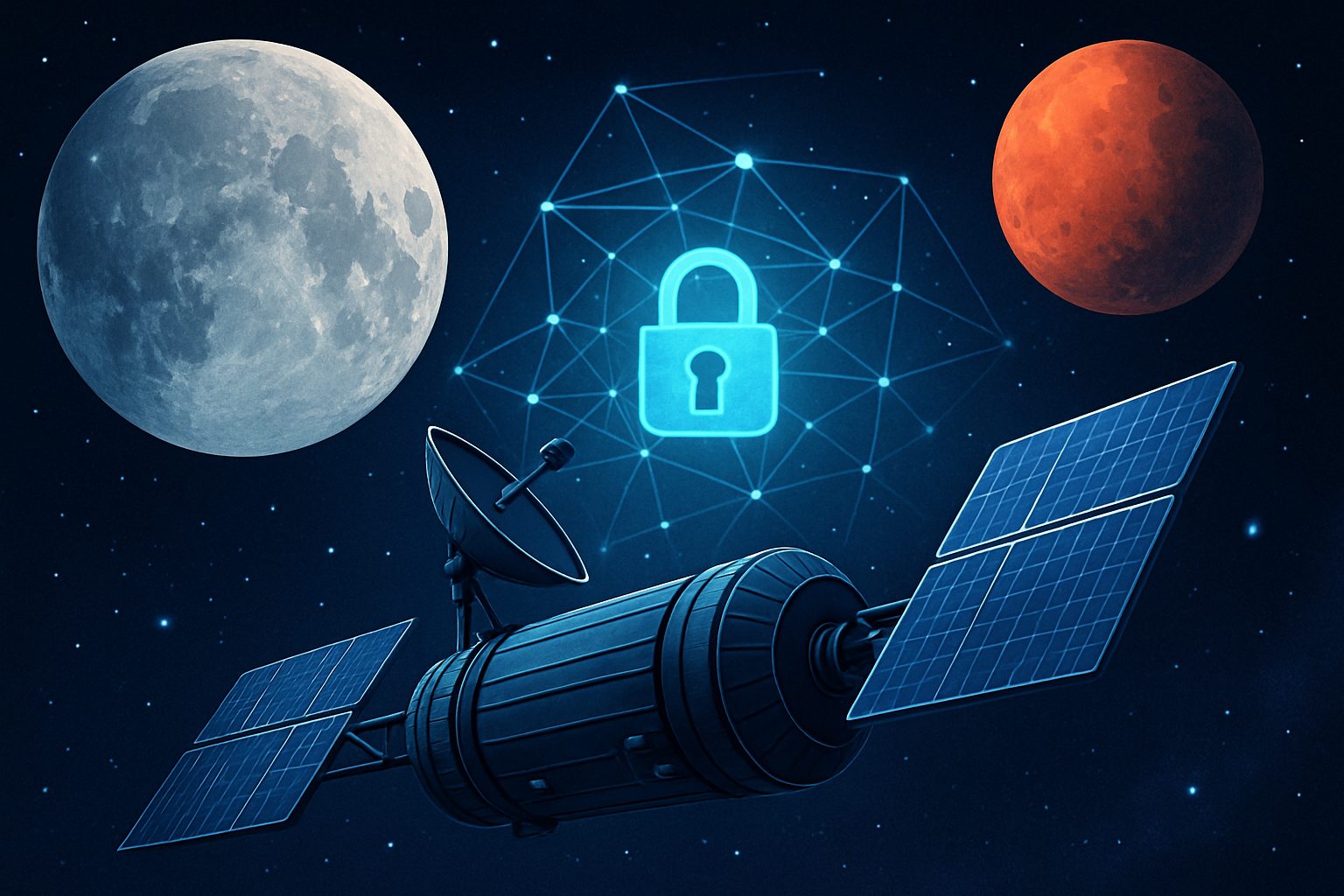
A recent demonstration of quantum-encrypted interplanetary communication has highlighted the emerging clash between exploration and privacy in space. As nations and private entities race to establish lunar and Mars networks, researchers are developing techniques to detect malicious payloads on satellites and pushing for new digital-rights frameworks under orbital law.
When a spacecraft beams images of Martian canyons back to Earth, it carries more than just scientific data. It also transmits metadata, network logs and system diagnostics that can reveal critical details about the architecture of ground stations, encryption methods in use and even the identities of engineers on duty. That hidden layer of information has become a prime target for state and non-state actors seeking to intercept or manipulate communications between planets.
Last month, researchers at the Advanced Communications Laboratory successfully demonstrated a quantum key distribution link between a prototype lunar relay satellite and a ground station in the Nevada desert. By encoding encryption keys in entangled photons, they achieved theoretically unbreakable security in an Earth-Moon-Earth channel. While the test lasted just a few minutes, it represents a milestone in the effort to lock down interplanetary messaging against eavesdropping or tampering-an achievement with profound privacy implications for future Mars missions.
Yet for every new safeguard devised in a lab, adversaries develop equally sophisticated methods to bypass it. Intelligence agencies have long deployed radio frequency scanners to sweep for payload anomalies and protocol fingerprints. In orbit, these tools can be retrofitted to rapidly scan neighboring satellites for unauthorized data exfiltration channels. Security analysts report that malicious code has already been implanted in at least two experimental research satellites, designed to relay telemetry to hidden ground stations outside international oversight.
To counter these covert operations, aerospace firms are adopting advanced anomaly-detection platforms that leverage machine learning to profile normal communication patterns and flag deviations in real time. By correlating uplink and downlink statistics, packet timing, frequency drifts and encryption handshake details, the system can isolate suspicious sessions that may indicate spyware activity. Early trials show detection accuracy above 95 percent, enabling operators to quarantine compromised nodes before they can relay sensitive information.
The push for stronger defenses goes hand in hand with a growing call for formal digital-rights protections in outer space. Civil society groups and policy think tanks are drafting proposals for an Outer Space Data Privacy Convention. Their blueprint would extend terrestrial privacy standards-such as purpose limitation, data minimization and individual consent-to orbital and deep-space infrastructures. Advocates argue that actors sending reconnaissance or communication satellites into high-altitude orbits should be legally bound to respect the privacy of other missions and the personal data of individuals on Earth.
On the other side of the debate, national security agencies warn that overly restrictive rules could hamper legitimate surveillance and reconnaissance essential to treaty verification, maritime security and climate monitoring. They propose carve-outs that prioritize transparency over outright prohibition, mandating public registries of payload capabilities and real-time disclosure of any non-scientific data collected. The tension between operational security and individual liberties mirrors discussions on Earth but is complicated by the challenges of enforcing laws across a rapidly commercializing celestial frontier.
Industry voices, meanwhile, are exploring privacy-preserving computation techniques to reconcile these competing demands. Homomorphic encryption, secure multi-party computation and zero-knowledge proofs are being tailored to satellite processors, enabling encrypted data analysis without revealing raw imagery or metadata. Imagine a climate-monitoring satellite that can compute regional sea-ice metrics under encryption and only share aggregate results-ensuring scientific collaboration without exposing proprietary algorithms or low-level operational details.
Beyond technical measures, ethicists stress the importance of governance frameworks that embed respect for autonomy and accountability into mission design. Responsible engineering checklists now recommend privacy impact assessments for any payload involving imaging, signal intelligence or metadata collection. These assessments evaluate risks to both individuals on Earth and other missions in orbit, ensuring that privacy is not an afterthought but a core requirement from concept to decommissioning.
Education and workforce development are key to sustaining these efforts over decades of exploration. Universities are launching interdisciplinary programs that blend astrophysics, cybersecurity and data ethics. Students learn to build encrypted deep-space radios, audit satellite firmware for backdoors and draft policy briefs for international conventions. This new generation of engineers and scholars will operate at the nexus of cosmos, privacy and digital rights, shaping how humanity safeguards its shared heritage in the stars.
As the world stands on the cusp of permanent lunar bases and Mars sample-return missions, the stakes have never been higher. The protocols and treaties we establish today will ripple through centuries of discovery, determining whether cosmic exploration becomes a new frontier for surveillance-or a beacon of trust, collaboration and respect for privacy. The challenge is to ensure that the same ingenuity driving our rockets skyward also guides the guardrails protecting our data, identities and freedoms, whether on Earth or among the stars.