Location
Mount Vernon, WA 98274
Location
Mount Vernon, WA 98274

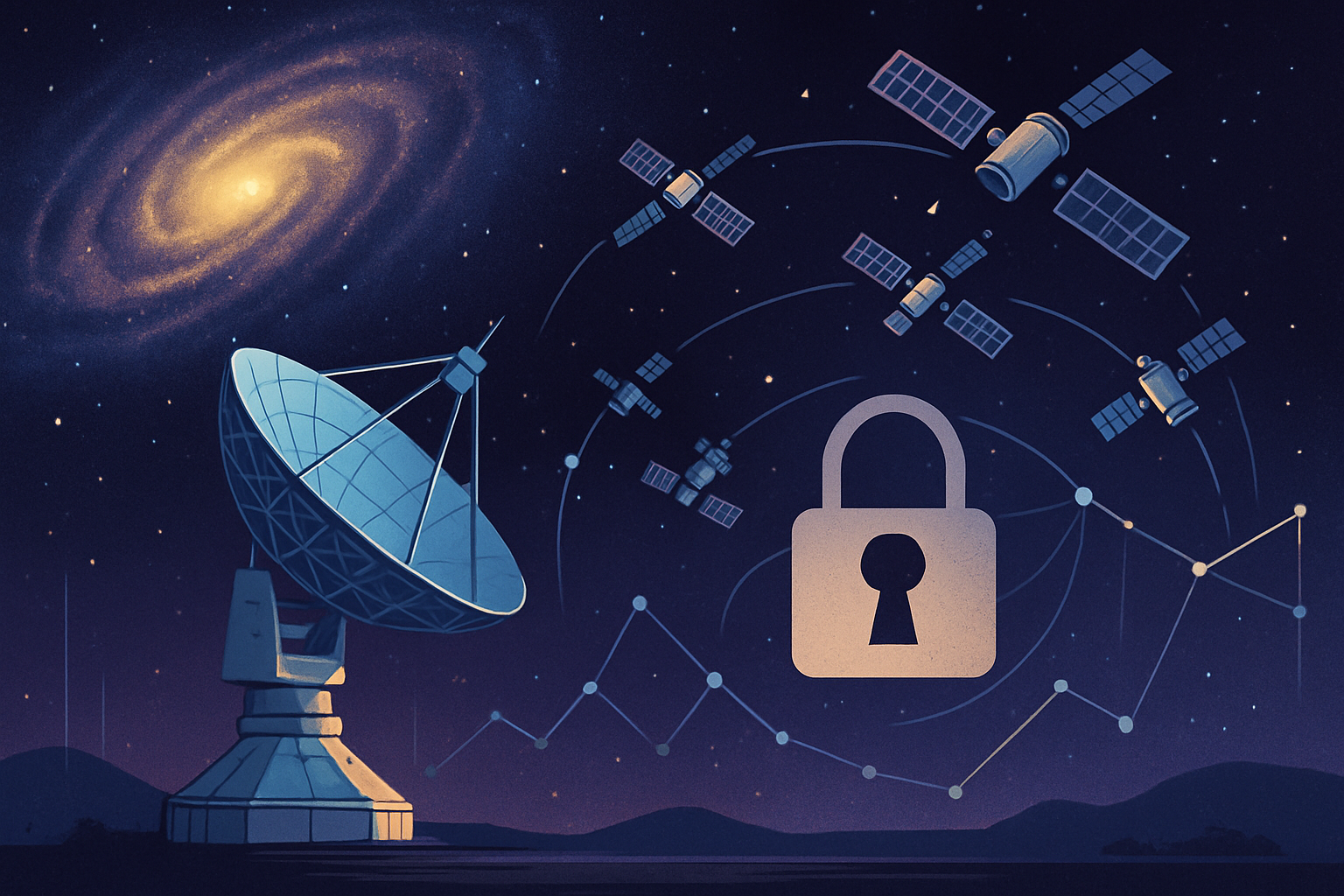
As humanity pushes deeper into the mysteries of space-time, telescopes and satellite networks are generating data at unprecedented rates-data that not only reveals cosmic secrets but also threatens to sweep up private communications and sensitive metadata. Researchers and policymakers are racing to build frameworks that balance open science, digital rights, and ethical technology in the skies above.
Across deserts and mountaintops, in high-altitude balloons and low-Earth orbit, instruments tuned to the faintest cosmic frequencies are gathering streams of information that promise to reshape our understanding of the universe. Powerful radio telescopes chart pulses from neutron stars; infrared observatories map ancient galaxies; gravitational-wave detectors record spacetime tremors from colliding black holes. Each discovery has propelled science forward, yet the same networks that capture distant quasars may inadvertently capture encrypted calls, wireless traffic, or clandestine drone telemetry emanating from the ground. In this tangled mesh of cosmic and terrestrial data flows, the frontier of space science now intersects with the battleground of privacy and surveillance.
Historically, space missions were launched by government agencies serving broad scientific or strategic goals. But the landscape has shifted dramatically: private companies deploy fleets of small satellites to beam broadband internet, universities crowdsource CubeSats for student research, and startups vie to develop orbital sensors capable of detecting everything from crop health to urban heat islands. The business models behind these constellations often rely on advanced signal processing and software-driven flexibility, enabling reconfiguration on the fly. However, these features raise questions: who controls the sensor parameters? Which signals are recorded, retained, or shared? And how do we prevent sensitive data-whether it’s a journalist’s encrypted transmission or a government’s diplomatic channel-from being swept up in a universal capture net?
Deep-space observatories and ground-based radio arrays typically filter out human-made interference to preserve signal integrity. Yet as you broaden the aperture of surveillance, ‘interference’ can become a trove of private information. Recent reports reveal that hobbyist satellite trackers have inadvertently decoded sections of commercial data links, while researchers experimenting with open-spectrum analysis detected fragments of IoT communications bouncing off low-orbit spacecraft. These serendipitous findings underscore a fundamental tension: the open ethos of space science-where data sharing accelerates discovery-can collide with robust privacy protections expected by individuals and organizations on Earth.
Beyond communications, firmware-level threats loom large in space hardware. Sleek cubesats and microsatellites often utilize off-the-shelf components running customized embedded software. Without rigorous security audits, malicious code may slip through, turning a scientific platform into a tool for espionage or data exfiltration. Companies delivering satellite buses are beginning to integrate firmware integrity monitors and remote attestation protocols, but these measures remain far from ubiquitous. Detecting a compromised chipset hundreds of kilometers above Earth demands novel approaches: anomaly-based intrusion detection tailored for sporadic telemetry patterns, cryptographic anchors to verify software authenticity, and out-of-band challenge-response mechanisms to root out hidden spyware.
On the ground, cybersecurity teams are developing specialized toolsets to classify and quarantine suspicious satellite traffic. Machine-learning models can sift through gigabits of time-stamped bursts, flagging deviations from expected spectral footprints. By training on benign broadcast patterns-from weather satellites to deep-space beacons-these systems can isolate unauthorized uplink or downlink channels. However, this forensic work raises legal and ethical questions: is it permissible for a research institute to surveil satellite signals originating from private facilities? At what point does network defense morph into warrantless monitoring of civil society? The absence of standardized norms means that each organization sets its own boundaries, resulting in a patchwork of privacy expectations across the orbital ecosystem.
Public policy has struggled to keep pace with this rapid convergence of cosmic science and digital rights. International treaties-like the Outer Space Treaty of 1967-focus on disarmament and freedom of exploration, but they predate the digital age. Regional frameworks governing satellite communications largely address spectrum allocation and environmental impacts; only recently have regulators begun to examine data sovereignty and surveillance risks. In some jurisdictions, law enforcement can access raw satellite feeds without a judicial warrant, while elsewhere private actors operate with near-total immunity. Civil society groups are calling for a new “space privacy charter,” advocating principles such as minimal data retention, transparent algorithmic processing, and user consent for any interception beyond the mission’s scientific scope.
Digital-rights organizations emphasize that universal access to cosmic data should not come at the expense of personal privacy. They argue for homomorphic encryption of on-board processing pipelines, enabling satellites to perform computations on encrypted inputs without ever exposing raw signals. Similarly, differential privacy techniques could add carefully calibrated noise to telemetry logs before sharing aggregated results, safeguarding individual communications while preserving scientific value. These privacy-preserving technologies remain experimental in the orbital context, but pilot programs are underway: one research collaboration has demonstrated an end-to-end encrypted link between a ground station and a small lunar orbiter, while another institute is testing secure multi-party computation to jointly analyze satellite imagery without revealing proprietary training data.
Ethical considerations extend further-in a realm where automated systems make split-second decisions about what data to archive or discard. Should a satellite equipped with on-board AI flag anomalous signals as potential intelligence threats? If so, what recourse does the signal’s originator have to appeal or redact? Without clear accountability, biased detection models could disproportionately target certain frequencies or ground locations, inadvertently entangling private users in surveillance dragnets. To mitigate such risks, ethicists advocate ‘explainable space AI,’ where every classification comes with an audit trail that humans can inspect. They also push for adversarial testing, subjecting detection algorithms to red-teaming exercises that uncover blind spots or calibration errors before deployment.
Collaboration across academic, commercial, and governmental stakeholders is essential to weave these technical and ethical threads into a cohesive framework. Some universities host interdisciplinary centers that bring together astrophysicists, cybersecurity experts, lawyers, and ethicists to draft best practices for space-data governance. Industry consortia form working groups to define standardized APIs for encrypted telemetry, secure satellite command protocols, and interoperable audit logs. International bodies convene stakeholders to negotiate binding standards that align with existing aerospace regulations and digital-rights charters. This patchwork of initiatives underscores a shared recognition: the promise of next-generation space science can only be realized if it embraces a privacy-by-design philosophy.
The stakes are high. In an era when space-borne sensors can map Earth’s surface with centimeter-level precision, capture faint radio signals from the farthest reaches of the cosmos, and conduct quantum experiments across interplanetary distances, the data they generate is a dual-use commodity. It can deepen our understanding of gravitational waves and dark matter while also enabling unprecedented surveillance of terrestrial activities. A failure to address the surveillance shadow cast by these technologies risks eroding public trust in space science, chilling innovation, and fueling geopolitical tensions.
Yet there is reason for optimism. Pioneering research teams have already demonstrated prototypes of privacy-preserving satellite networks. Leading space agencies incorporate security-by-design principles into flagship missions. Civil society organizations are mobilizing to draft ethical guidelines, and a new generation of engineers is learning about spatial data ethics alongside orbital mechanics. By forging a culture where technical excellence and moral responsibility go hand in hand, the community can build an orbital ecosystem that unlocks cosmic insights without compromising the privacy and rights of those on Earth.
As humanity charts its course across the cosmic ocean, the design choices we make today will echo for decades to come. Every encryption scheme hardened, every auditing framework codified, and every legal standard ratified shapes a spacefaring future where telescopes and satellites serve not only as windows to distant galaxies but as guardians of personal freedoms. In this emerging frontier, science and ethics are inseparable companions, guiding us toward a universe that is both open to exploration and respectful of individual privacy.