Location
Mount Vernon, WA 98274
Location
Mount Vernon, WA 98274

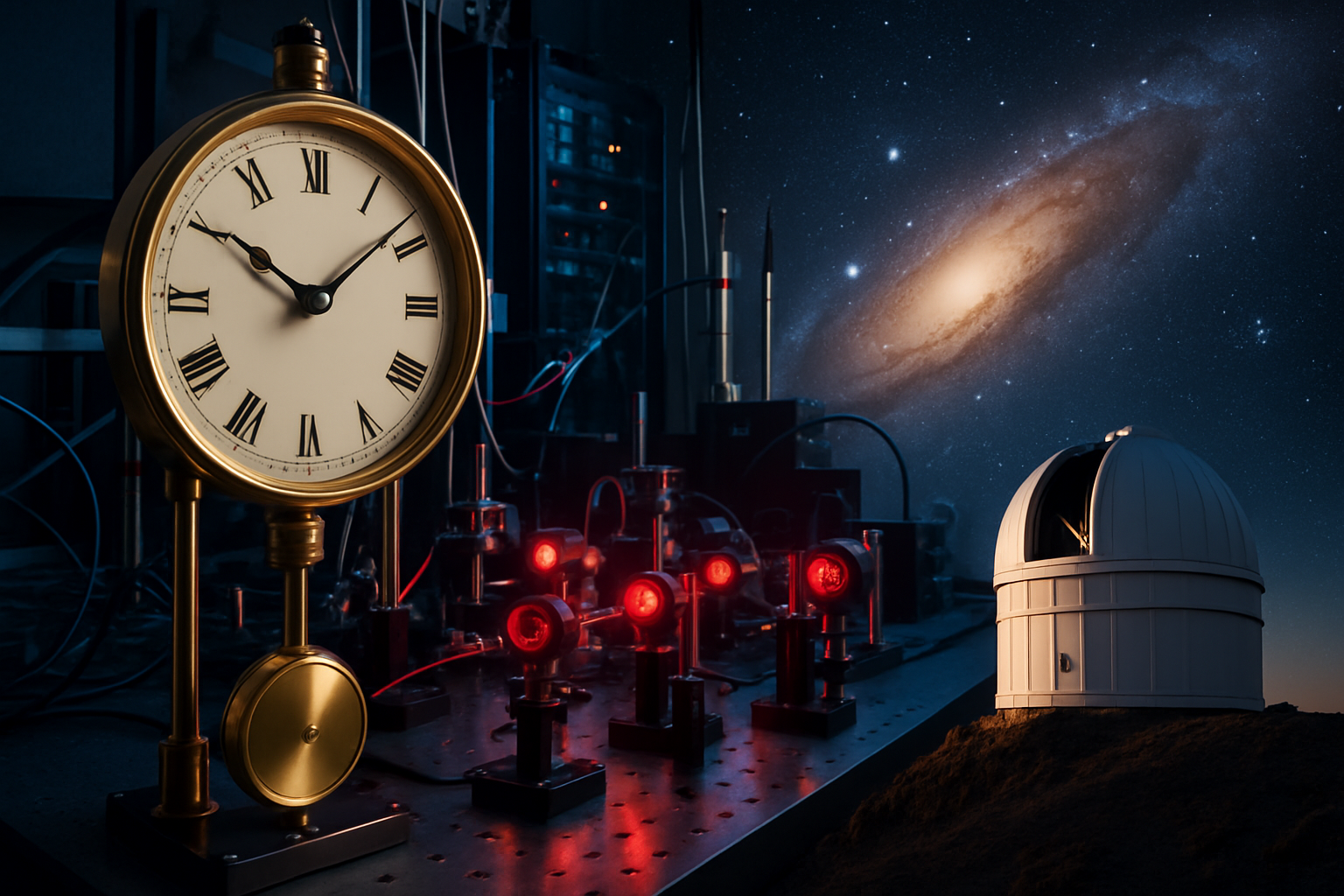
Cutting-edge experiments are reshaping our understanding of how time and matter intertwine-from unprecedented clocks to elusive dark-sector searches. Across laboratories and deep-space observatories, researchers are piecing together clues that could transform physics and spark a new era of discovery.
In a sprawling subterranean laboratory, scientists fine-tune an array of lasers and electromagnetic traps. Nearby, a precision atomic clock ticks faster and more accurately than anything before it, challenging established notions of how time itself might behave under extreme conditions. At the same time, detectors buried deep underground stand poised to capture the faintest whisper of dark matter particles, potentially unraveling one of the universe’s oldest enigmas. From quantum laboratories to mountain-top observatories, a global community of researchers is converging on questions that have long teased philosophers and physicists alike: What is time, what is matter, and how do their hidden interactions shape our reality?
Recent advances in timekeeping are spearheaded by optical lattice clocks, which trap thousands of neutral atoms in a standing wave of light. By measuring tiny shifts in energy levels, these devices have achieved stabilities at the 10−18 level-a precision so fine that it could detect the gravitational potential difference between floors in a skyscraper. Such sensitivity opens doors to testing general relativity in tabletop experiments and even exploring whether fundamental constants evolve over time. Already, teams in Europe and North America are racing to benchmark clocks at distant sites via fiber-optic networks, searching for minute discrepancies that could hint at new physics beyond Einstein.
Meanwhile, at particle physics facilities around the world, researchers probe the asymmetry between matter and antimatter. The enduring mystery of why our universe is dominated by matter has spurred experiments focusing on subtle violations of time-reversal symmetry. By comparing the decay patterns of subatomic particles with those of their antimatter counterparts, scientists hope to pin down sources of CP violation not accounted for in the Standard Model. Recent results have hinted at slight anomalies, fueling plans for next-generation detectors capable of recording billions of collision events per second.
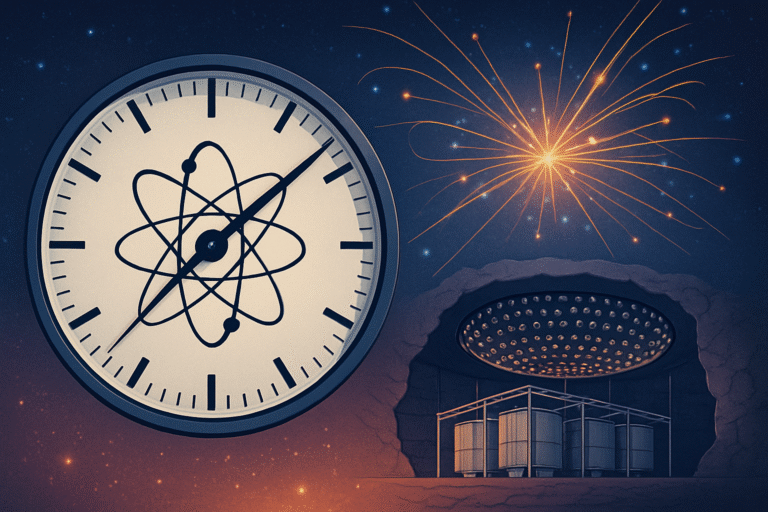
In parallel, the hunt for dark matter has entered an era of unprecedented sensitivity. Deep underground in shielded caverns, ultra-pure liquid xenon chambers and cryogenic crystal arrays await rare scattering events. The latest generation of experiments promises to improve detection thresholds by orders of magnitude, bringing within reach the so-called “WIMP miracle” parameter space. Should these detectors record a telltale flash of light or phonon signal, it would mark the first direct observation of dark matter particles interacting with normal matter-a breakthrough with profound implications for cosmology and particle physics.
Space-based observatories contribute a complementary perspective. A fleet of satellites monitors the cosmic microwave background with ever-increasing resolution, hunting for faint imprints of primordial gravitational waves. Such signals would carry information about inflation-the explosive growth of the universe in its earliest moments-and could reveal how quantum fluctuations seeded the large-scale structure we observe today. At the same time, neutrino telescopes embedded in Antarctic ice and deep-sea detectors track ghostly particles from supernovae and distant galaxies, offering clues to processes that power the most energetic phenomena in the cosmos.
On the quantum frontier, researchers have realized a long-sought state of matter known as a time crystal. First proposed in 2012 and subsequently observed in driven quantum systems, time crystals exhibit periodic oscillations in their ground state-effectively breaking time-translation symmetry. These exotic phases could one day serve as robust memory registers in quantum computers, or as sensitive probes of temporal correlations in complex materials. Current efforts focus on scaling up time-crystal platforms, exploring how they interact with their surroundings and whether they can withstand decoherence in practical settings.
At the intersection of gravity and quantum mechanics, scientists explore analog models of curved spacetime in laboratory settings. Ultracold atomic gases, for instance, can mimic event horizons and Hawking radiation, allowing physicists to study black-hole analogs on benchtop apparatus. These experiments offer a glimpse into how matter behaves under extreme gravitational fields, and whether quantum fluctuations of spacetime leave measurable imprints. By bridging the gap between theory and experiment, researchers hope to inch closer to a unified description of gravity and the quantum world.
Beyond fundamental pursuits, these breakthroughs carry practical implications. Next-generation atomic clocks are poised to enhance global navigation systems, improve synchronization of power grids, and refine geophysical surveys. Dark matter detectors push detector-technology into realms useful for low-background imaging, medical diagnostics, and national security applications. Quantum platforms developed to manipulate time crystals and entangled states are driving innovation in secure communications and ultra-sensitive sensors.
Yet profound mysteries remain. Why do the fundamental constants maintain their observed values? Is time truly continuous, or does it have a discrete substructure at the Planck scale? What is the true nature of dark energy driving cosmic acceleration? Even as experiments peel back layers of complexity, each answer seems to open new questions, reminding us that the universe still harbors secrets beyond our imagining.
International collaborations are expanding to tackle these puzzles. Multi-messenger astronomy-combining electromagnetic, gravitational, and neutrino observations-has already transformed our view of astrophysical events. Soon, coordinated campaigns will synchronize quantum clocks worldwide, creating a network sensitive enough to detect passing gravitational waves from merging neutron stars via tiny time delays. Parallel efforts aim to link dark matter observatories across continents, correlating any candidate signal with astronomical anomalies.
Private and public funding agencies are responding with bold initiatives. New research centers dedicated to “foundations of physics” are sprouting in university campuses, equipped with state-of-the-art quantum labs and deep-earth facilities. Industrial partnerships are fueling prototype development of quantum sensors and future timekeeping networks, with an eye toward commercialization and societal benefits. In this ecosystem, the boundary between pure research and practical innovation is more permeable than ever.
Back in the laser-lit hall of the atomic clock lab, graduate students analyze streams of data, watching for subtle shifts that could herald new physics. A single unexpected deviation might rewrite textbooks, but even null results refine our understanding of nature’s limits. As night falls outside, the clock’s heartbeat continues unchanged, a testament to human ingenuity and the unyielding march of science.
Across countless experiments and observatories, a single narrative emerges: time and matter are entwined in astonishing ways, a dance choreographed by fundamental forces and quantum fluctuations. We stand at the threshold of discoveries that could redefine our place in the cosmos and reveal a deeper order underpinning reality. While the path ahead may be strewn with dead ends and false leads, each step brings us closer to truths that have beckoned since antiquity. In pursuing time, matter, and mystery, we embark on a journey without end-a testament to curiosity, collaboration, and the indomitable human spirit.
Whether through a fleeting photon in a dark-matter detector, a synchronized tick across continents, or an oscillating time crystal, the universe continually invites us to explore its hidden dimensions. As researchers press forward, one thing is certain: the interplay of time and matter will continue to inspire wonder, drive innovation, and shape our understanding of everything we call real.