Location
Mount Vernon, WA 98274
Location
Mount Vernon, WA 98274

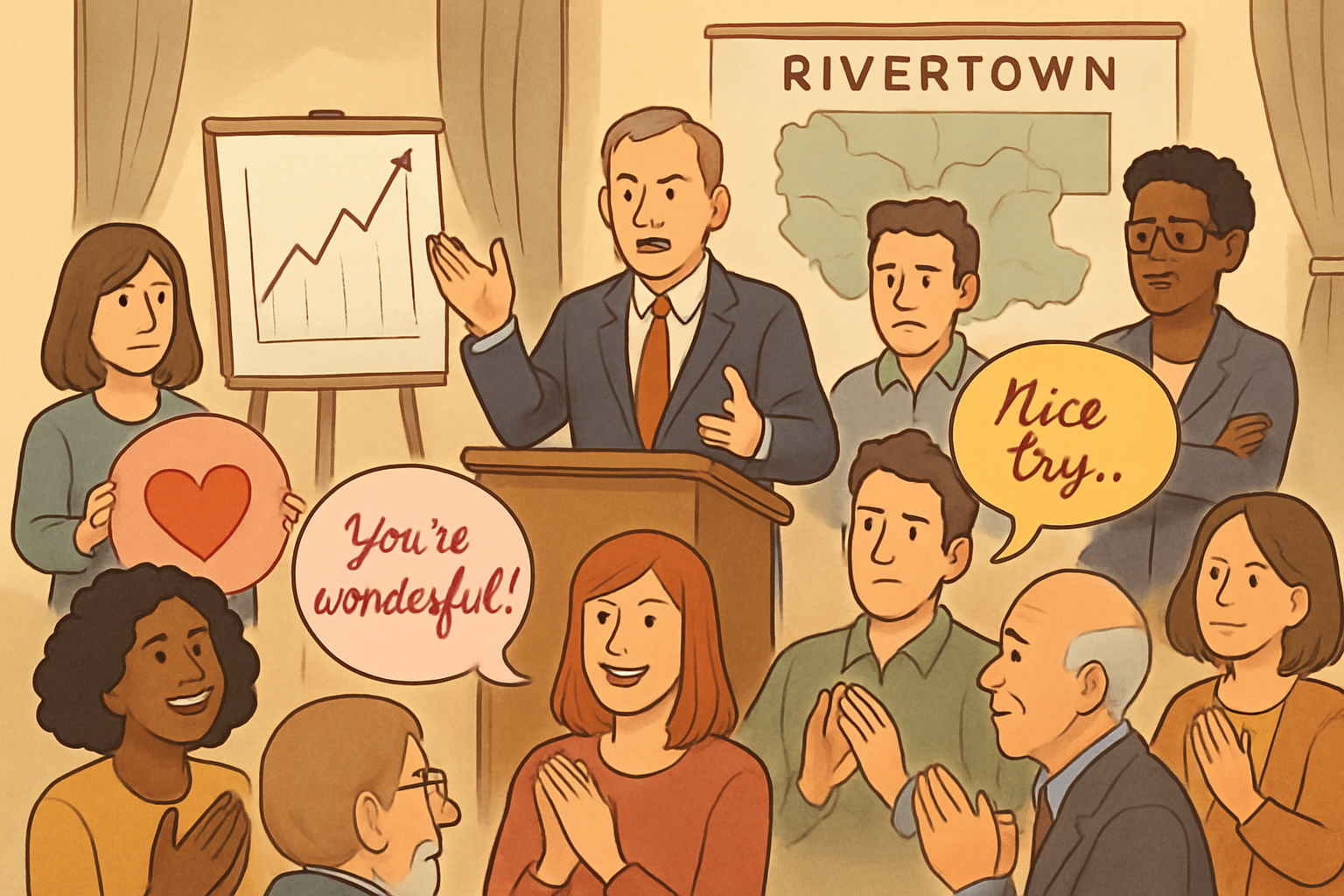
In an unprecedented economic experiment, residents of Rivertown have swapped dollars for heartfelt praises, creating a local "Compliment Currency." What began as a friendly challenge has sparked inflation of absurdly effusive greetings, a black market for backhanded compliments and an emergency summit to rescue the economy from hyper-flattery.
Rivertown woke up this Monday to discover that its longstanding local currency had been quietly replaced by a system of compliments. Instead of handing over change at the corner café, customers now offer phrases like “Your latte art transcends the limits of time and space” or “You, barista, radiate the warmth of a thousand summer suns.” The switch wasn’t mandated by City Hall; it was the brainchild of a small group of neighborhood optimists who believed that heartfelt kindness could drive an entire economy.
It all began two weeks ago when the Rivertown Neighborhood Alliance announced a weekend “Compliment Swap”-a pop-up event in the community park where residents could trade compliments like baseball cards. Within hours, participants formed impromptu lines, and what started as a lighthearted social experiment quickly became an all-out currency revolution.
Local café owner Maria Jenkins says her morning traffic doubled overnight, not because of lower prices but due to people eager to spend compliments. “I had someone say they’d give me 17 factory-fresh metaphors in exchange for a muffin,” she recalls. “Usually I worry about coin shortages, but this week I’m just begging for more inspiring adjectives.”
Banks adapted fast. Rivertown Savings and Praise Bank opened a “Compliment Vault,” where citizens could deposit lines of kind remarks-everything from “Your sense of humor rekindles childhood innocence” to “Your spreadsheet formatting is a revelation.” Withdrawals are made in the same currency: a teller might hand out “20 genuine nods of approval” or even a choice “hand-on-shoulder gesture of solidarity.”
But the system isn’t without its challenges. Within days, financial institutions had to draft terms of service clarifying that sarcasm does not count as currency. Some customers attempted to launder flippant quips-deliver a grumpy mutter, then hope it counts as a compliment once an empathy compliance officer signs off.
Inflation soared when high-profile residents began hoarding compliments as status symbols. A board member at the art museum demanded a personal compliment before approving exhibit budgets. One schoolteacher refused to hand out report cards until students wrote preemptive praise for the entire faculty. Every compliment’s market value plummeted as the supply outstripped demand.
Black markets emerged in shadowy corners of the city. In one sketchy basement, a group offered “Authentic-Feeling Compliments” for premium prices-ensuring they sounded heartfelt by using rarely heard words like plangent and ineffable. The so-called Underground Applause Syndicate charged extra for backhanded compliments, guaranteeing awkwardness and mild existential dread with each purchase.
Amid the chaos, Mayor Duncan Clarke convened an emergency town hall meeting. The echoing gymnasium was filled with residents waving signs that read things like “Give Us Genuine Love, Not Just Lip Service!” and “Put the ‘Kind’ Back in ‘Kindness.'” Clarke acknowledged that while the experiment had fostered friendly vibes, it threatened to reduce meaningful praise to an overused commodity. “We can’t let compliments become as meaningless as loose pennies,” he warned.
Economic experts flown in from the neighboring city of Meadowbrook tried to steady the situation. Dr. Serena Wu, a behavioral economist, cautioned against overcounting compliments. “Humans experience true gratitude in nuanced contexts-if you hear ‘Your haircut is nice’ ten thousand times in one day, it ceases to feel genuine,” she explained. Wu proposed a regulatory framework: a limit of 50 compliments per person per day, and a standardized compliment-to-value conversion rate.
Resistance was immediate. A coalition of self-styled “Compliment Alchemists” argued that capping heartfelt kindness undermines the experiment’s spirit. They organized a flash-massed praise parade, handing out free compliments in exchange for silence. By midday, they had conducted a silent compliment bombardment on City Hall’s front steps.
Meanwhile, ordinary residents found themselves in strange new dilemmas. Construction worker Elena Santos admits she once flat-out forgot how to say “thank you” without counting it against her daily compliment quota. And phone etiquette at the local pizza joint is now a delicate operation-“Your pepperoni arrangement exhibits admirable symmetry” might get you a deep‐dish pie, but hit your daily limit, and you’re relegated to a curt “Enjoy your meal.”
Neighboring towns have started to look on with fascination-and relief that they aren’t dealing with hyper-inflated kindness. A delegation from Westvale stopped by last week, hoping to replicate the model, only to return home shaken by an unsolicited avalanche of praise that lasted three hours. “We’re still recovering emotionally,” one visitor admitted.
Back in Rivertown, the city council approved the formation of a Compliment Stabilization Board to calibrate the system until the next public hearing. Some residents fear the measures won’t be enough to bring compliments back from the brink of absurdity. But for now, shopkeepers, waitstaff and neighbors continue to trade heartfelt remarks for everyday goods-hoping that one day their greeting won’t just be another digit in an infinite compliment ledger.
As the sun sets on another tumultuous day in Rivertown’s economy, the question remains: can genuine warmth coexist with a regulated market of praise? Or will the next fiscal quarter be remembered as the era of meaning-starved flattery and backhanded bargains? Either way, Rivertown has embarked on an unforgettable social experiment-proving that even the simplest kindness, if turned into currency, can redefine what community really means.